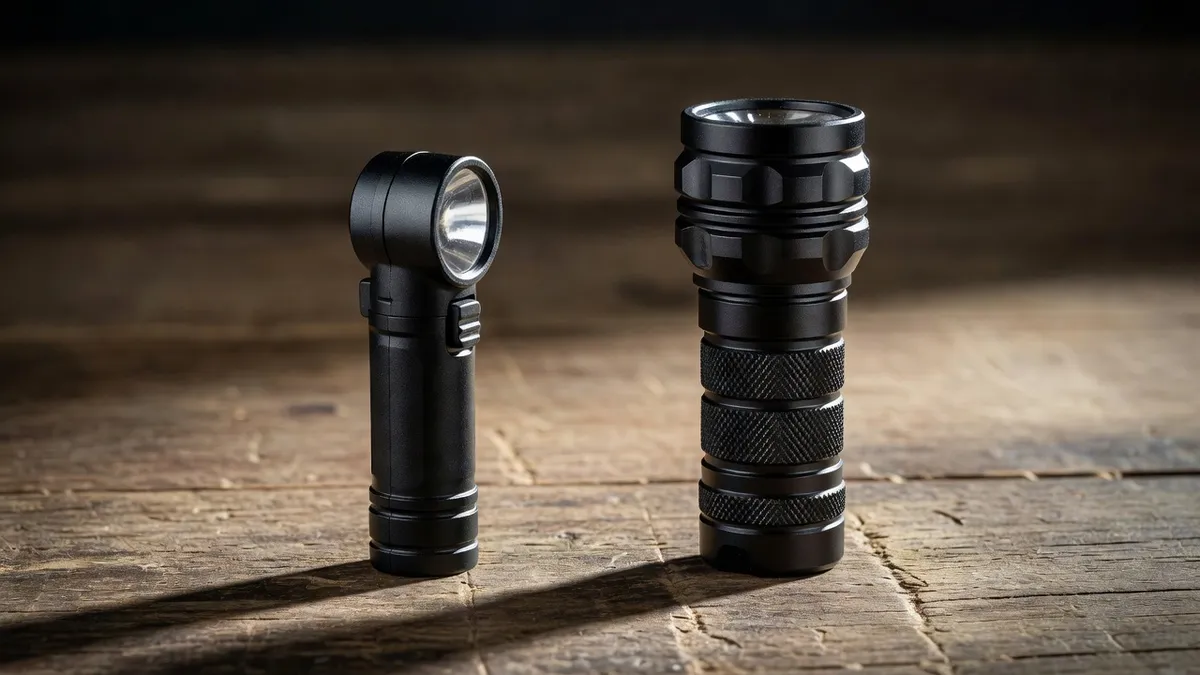
$20 vs $100 Flashlight: What You Actually Get for the Money
Quick answer: The extra money mostly buys things that don’t show up in the product photo: honest output ratings, a regulated driver that holds brightness steady, a safe protected battery, waterproofing that’s actually been tested, and a warranty someone will honor. A $20 light from a reputable budget brand is genuinely enough for the kitchen drawer and the car. The $100 light earns its price the moment you depend on it — camping, storms, work, every day. The trap is the $20 light pretending to be the $100 one.
Let’s open both up and see where the $80 goes.
The Spec-Sheet Illusion
Search Amazon for flashlights and you’ll find $18 lights claiming “990,000 lumens” next to a $100 Fenix rated at 1,700. The cheap light is not 580× brighter — it’s lying, and the premium one is measured. That single difference explains most of the price gap:
- ANSI FL1 ratings. Reputable brands (Fenix, Olight, Streamlight, Nitecore — compared here) publish output, runtime, beam distance, and impact resistance measured to the ANSI/PLATO FL 1 standard. No-name lights print whatever number sells. We tore into one of these claims in our Sunitact “990,000 lumen” review.
- Turbo honesty. Premium lights tell you turbo lasts 2 minutes before stepping down; cheap lights just dim quietly and hope you don’t notice.
Where the $80 Actually Goes
| Component | The $20 light | The $100 light |
|---|---|---|
| LED emitter | Unbranded, cool blue tint, uneven beam | Name-brand (Cree, Luminus), tested bin, clean beam |
| Driver circuit | Direct drive — dims as the battery drains | Regulated — constant brightness until near-empty |
| Battery | Unprotected cell of unknown origin, or 3×AAA | Protected, branded 18650/21700, USB-C charging |
| Waterproofing | ”Waterproof” (a word) | IPX8/IP68 (a test) |
| Body & threads | Thin aluminum, dry threads, sharp edges | HA-III anodizing, greased square threads, glass lens |
| Modes & UI | Strobe you can’t skip, forgets your last mode | Mode memory, lockout, moonlight mode |
| Warranty | The return window | Limited lifetime, real support |
Two of these deserve special attention:
The driver is the biggest hidden difference. A regulated driver holds output flat as the battery drains, then warns you. A direct-drive light starts dimming from the first minute — the “800 lumens” is 400 within half an hour. This is invisible on the box and obvious in the woods.
The battery is the safety difference. Unprotected, unbranded lithium cells in sealed cheap lights are where flashlight horror stories come from. Premium lights ship protected, traceable cells with real charging circuits — a large part of what you’re paying for is what won’t happen in your pocket. (Traveling? Either way, batteries fly in the cabin.)
When the $20 Light Is the Right Call
Honesty cuts both ways — plenty of jobs don’t need the premium light:
- The junk drawer, car door, and garage shelf — lights that get used ten minutes a year
- Kids — a first flashlight will be dropped in a lake; let it be a cheap one
- Bulk placement — one light per room for storm season beats one perfect light in one room
- Loaners — the light you hand to a neighbor should be one you can afford to never see again
The key is buying a reputable budget light rather than a lying one: a Streamlight PolyTac or entry-level Nitecore at $25–$35 gives you honest specs with a budget build — the actual sweet spot for most people.
When the $100 Light Pays for Itself
- Daily carry — anything used daily amortizes to pennies; buy once
- Camping, hiking, hunting — regulated output and real waterproofing are the difference between gear and toys (our camping picks)
- Work — if a dead light stops the job, the warranty and build quality are the product
- Emergencies — the Fenix PD36R V2.0 runs up to 482 hours on its lowest mode, so one charge outlasts a long blackout
The Verdict
Think in three tiers, not two:
- $15–25: honest budget brands only — drawer, car, kids, loaners
- $35–70: the value sweet spot — 90% of premium performance (best sellers live here)
- $90–130: buy-once lights for people who use them like tools — check the PD36R
The only wrong purchase is the $20 light wearing a $100 light’s claims. Check for ANSI ratings, a named LED, and a real warranty — our buying checklist covers the rest.
FAQ
Is a $300 flashlight ever worth it? For specialized users (SureFire duty lights, extreme throwers like the ones in our long-range guide) — yes. For everyone else, diminishing returns start around $130.
Do cheap lights really overstate lumens? Routinely, sometimes by 100×. Independent testing communities (BudgetLightForum, r/flashlight) document it constantly. ANSI-rated brands are the fix.
What’s the single best upgrade from a cheap light? USB-C rechargeability with a regulated driver — the jump from “dimming AAA junk” to “constant, rechargeable output” is bigger than any lumen increase. See the USB-C guide.
So where’s the sweet spot? Right around the $30–$50 mark, where onboard USB-C, high-CRI emitters and real water ratings all become standard. Our four picks are in best EDC flashlights under $50.