Butane vs Lighter Fluid: Which Zippo Insert Should You Buy?
Quick answer: Keep the standard wick insert if you want the classic soft flame and the lifetime guarantee that makes a Zippo worth owning. Switch to a butane insert only if you specifically need a hot torch flame — for cigars, at altitude, or in cold — and you accept two real costs nobody mentions: the butane insert is covered by a two-year warranty, not the lifetime guarantee, and it does not fit Slim, Armor, or 1935 Replica cases. Details below.
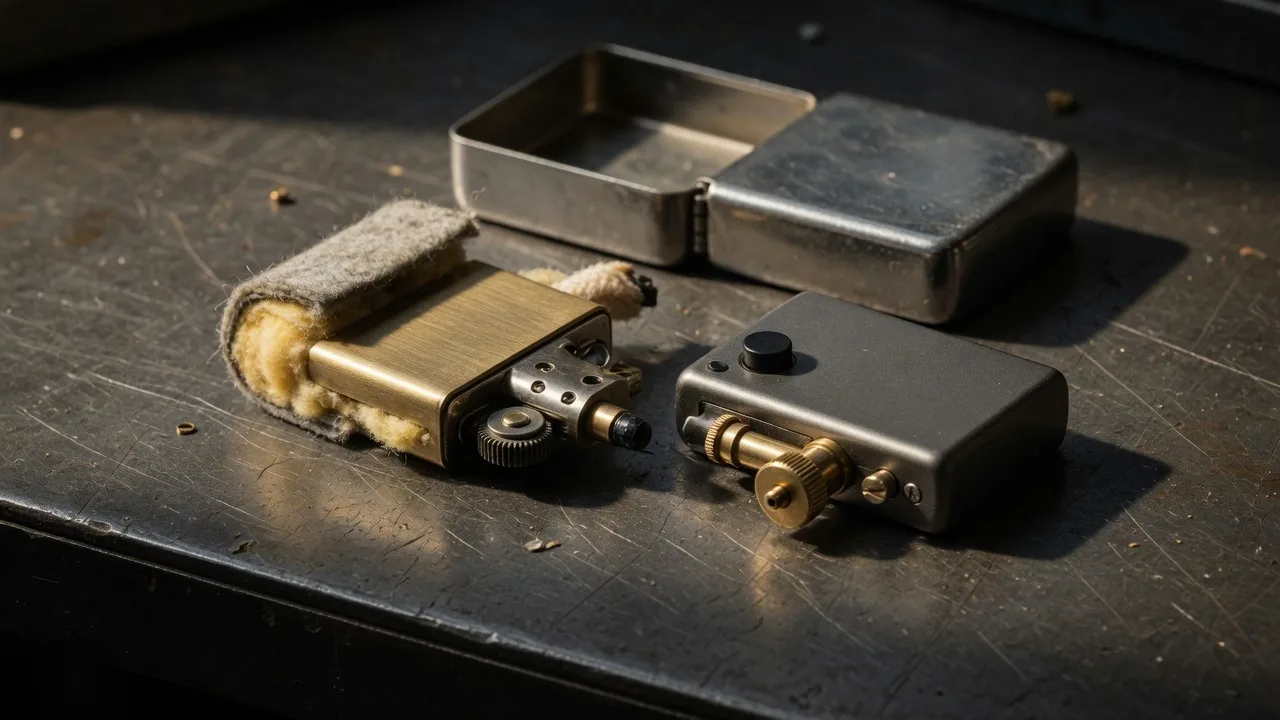
The insert is the metal chassis that lifts out of your Zippo case. The case is just a shell — swapping inserts is how you change what the lighter actually does, and it takes about two seconds. That flexibility is why “which Zippo insert should I buy” gets asked constantly, and why the answer is less obvious than the product listings make it look.
Read this before you buy: you are trading away the guarantee
Zippo’s lifetime guarantee is the single best reason to own one. Send in a mechanically broken lighter from any decade and Zippo repairs it free — the policy we cover in full in our Zippo repair guide.
That guarantee does not extend to the butane inserts. Zippo’s own product page for the Single Torch insert states it is “backed by a two-year Zippo warranty.” The lifetime promise stays with the case and its standard wick mechanism; the pressurised butane unit is a separate two-year product.
This is the trade almost every “best Zippo insert” listicle skips. You are swapping a lifetime-repairable mechanism for a sealed gas unit with a fixed warranty window. Sometimes that is the right call. It should be a decision, not a surprise.
The fit problem
Straight from Zippo’s Single Torch listing: it “fits all classic Zippo lighter cases” but does not fit Slim®, Armor®, or 1935 Replica cases.
That rules out a lot of lighters people specifically want to upgrade. Slim cases are narrower, the 1935 Replica has different internal dimensions, and Armor cases use thicker walls that reduce the interior cavity. Zippo’s knowledge base adds a further wrinkle: single and double torch inserts date-stamped J20 through L22 may not fit Armor cases even where a later one would.
Check which case you own before you order. A butane insert that does not fit is not a repair job — it is a return.
What each insert actually is
Zippo list prices, direct from Zippo, as of August 2026. Street prices on Amazon move around.
| Insert | ~Price | Fuel | Flame | Warranty |
|---|---|---|---|---|
| Standard wick (comes in the lighter) | included | Naphtha lighter fluid | Soft yellow, windproof chimney | Lifetime guarantee |
| Single Torch Butane | ~$21 | Butane | Blue jet torch, adjustable | 2 years |
| Double Torch Butane | ~$24 | Butane | Two blue jets, hotter | 2 years |
| Yellow Flame Butane | ~$24 | Butane | Soft yellow, butane-fuelled | 2 years |
| Pipe insert (wick) | from ~$18 | Naphtha | Angled soft flame for pipe bowls | — |
| Yellow Flame Pipe Butane | ~$24 | Butane | Downward flame for pipes | 2 years |
| Double Arc Rechargeable | ~$27 | USB charge | Twin plasma arcs, no flame | 2 years |
| Bit Safe Screwdriver | ~$20 | none | Not a lighter at all | — |
Two of those deserve a note. The Yellow Flame Butane insert is the interesting middle option — it gives you a soft, classic-looking flame while running on butane, so you get the no-evaporation benefit without the blowtorch. And the Double Arc Rechargeable was showing sold out when we checked; if you want an arc flame, our arc lighter guide covers standalone units that are easier to actually buy.
Butane vs lighter fluid: the real differences
Evaporation is the whole argument
A standard Zippo runs on naphtha held in cotton batting, and naphtha evaporates through the wick whether or not you ever strike it — typically emptying in one to two weeks of sitting in a drawer. That is the most common complaint about Zippos and the reason so many are found dead when needed. We go through the numbers in how long a gas lighter lasts.
Butane is sealed under pressure and does not evaporate away. A butane insert that you filled three months ago will still light. If your Zippo lives in a drawer for emergencies rather than in your pocket, this single fact is the strongest argument for switching.
Runtime per fill
Zippo rates the Single Torch at “up to 100 5-second ignitions per fill” from a 0.9 g capacity; their refillable butane category page claims up to 125 lights per fill. Either way, expect somewhere around a hundred uses between refills — noticeably less total burn time than a well-fed wick insert, but the fills are far less frequent because nothing leaks away between them.
Flame behaviour
A torch flame is hotter, narrower, and genuinely wind-resistant — it will relight a cigar in a breeze that defeats a soft flame. It is also the wrong tool for some jobs: too aggressive for lighting a pipe properly, and it will scorch what a soft flame would simply light.
The classic wick flame is not defenceless, either. The chimney design is the original windproofing and it works. And it stays lit — a torch cuts out the instant you release the button.
Cold and altitude
Butane struggles in cold (it stops vaporising properly near its boiling point around −0.5 °C) and its output shifts with altitude, which is why the flame-height screw exists. Naphtha is far less temperature-sensitive. For genuinely cold-weather use, the standard insert is the more reliable of the two — or skip the flame entirely, as we argue in Zippo vs BIC vs arc lighter.
Fuel cost and availability
Both fuels are cheap and widely sold. Zippo’s knowledge base specifically recommends Zippo or Ronson butane, which are refined for use in their products — cheap unrefined butane is the usual culprit behind a clogged valve. Standard inserts take any naphtha-based Zippo lighter fluid.
So which one should you buy?
Keep the standard wick insert if: you carry the lighter regularly, you like the ritual and the soft flame, or you value the lifetime guarantee. This is most people. The standard insert is also the only one you can service yourself indefinitely — wick, flint, and felt are all user-replaceable.
Buy the Single Torch butane insert if: you light cigars, you need wind and altitude performance, or your Zippo sits unused for weeks and you are tired of finding it dry. Single torch inserts on Amazon.
Buy the Double Torch if: you light cigars specifically and want an even, faster light across a wider ring gauge. It burns fuel quicker for the same fill.
Buy the Yellow Flame Butane if: you want the classic look without the evaporation. The most underrated option in the range.
Buy nothing if: your case is a Slim, Armor, or 1935 Replica. Confirm fit first.
Not sure the Zippo platform is right for you at all? Zippo vs BIC vs arc lighter runs the yearly cost math on all three, and the Zippo gift guide breaks models down by budget.
Zippo butane insert not working? Start with vapor lock
Nearly every “my butane insert won’t light” complaint is vapor lock — trapped air in the fuel chamber blocking the butane. It is not a fault, and the fix is free.
- Purge the insert. Press the fill valve with a small flathead screwdriver until all gas and air hisses out. Do this outdoors, away from any flame.
- Fill in short bursts. Hold the can upside down against the valve for 5–6 seconds at a time, not one long push.
- Repeat the purge-and-fill cycle if the flame is weak or absent.
- Wait two minutes before attempting ignition. The fuel needs to settle and the insert needs to return to room temperature — it will feel cold after filling.
- Adjust the flame with the screw on the bottom of the insert, using a flathead screwdriver, a dime, or a paper clip.
If it still will not light, check the ignition wire position. Zippo specifies it should sit at a 90-degree angle on the single torch, and between the burners on the double torch. A wire knocked out of place produces a spark that never reaches the gas.
Two more causes worth ruling out: unrefined butane clogging the valve (use Zippo or Ronson), and simple cold — warm the insert in your hand for a minute before blaming it. For non-Zippo butane lighters showing the same symptoms, see fixing a lighter, and read our safety guide before doing any of this near a flame.
FAQ
Does Zippo make a torch lighter? Yes, as an insert. Zippo’s torch lighter is the Single or Double Torch butane insert, which drops into a classic Zippo case in place of the wick insert and gives a blue jet flame. It carries a two-year warranty rather than the lifetime guarantee, and it won’t fit Slim, Armor or 1935 Replica cases.
Can I put butane in a standard Zippo insert? No. The standard insert is an open cotton reservoir designed for naphtha — it cannot hold pressurised gas. Butane requires the dedicated pressurised insert. Improvising here is a genuine safety risk.
Does the butane insert void my Zippo’s lifetime guarantee? No. The guarantee covers the case and its standard mechanism, and inserts are consumable parts — swapping one changes nothing about the case’s coverage. But the butane insert itself carries only a two-year warranty, so the swapped-in part is not lifetime-covered.
Will a butane insert fit my Slim Zippo? No. Zippo states the torch inserts do not fit Slim®, Armor®, or 1935 Replica cases. Classic cases only.
Does the butane insert still make the Zippo click? Yes — Zippo specifically engineered the click into the butane inserts. The lid action feels the same.
How many lights do I get per fill? Zippo rates the single torch at up to 100 five-second ignitions from 0.9 g of fuel; the category page claims up to 125 lights. Real-world use lands in that range.
Why is my insert cold and weak right after filling? That is normal — rapid decompression chills the fuel. Wait two minutes before lighting.
Can I go back to the wick insert later? Yes, instantly. Keep the original insert; both drop into the same classic case, so you can switch based on the season or what you are lighting.