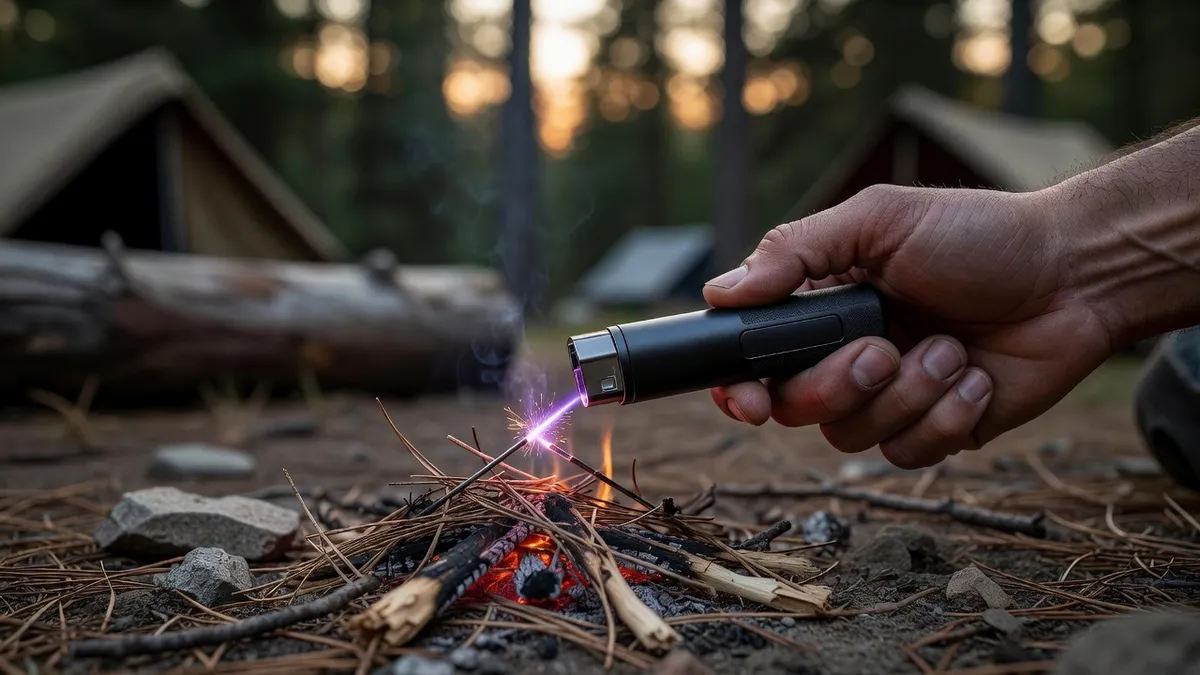
Best Arc Lighters for Camping & Home (Windproof, USB-C)
Quick answer: An arc lighter (also called a plasma lighter) ignites with a small electric arc instead of a flame — which makes it genuinely windproof, fuel-free, and USB rechargeable. For camping, backpacking, and emergency kits, a dual-arc lighter is the most practical fire-starter you can carry; for candles and stoves at home, a flexible-neck arc lighter reaches wicks a pocket lighter can’t.
Arc lighters are the biggest shift in lighter technology since butane, and they’re the one product category this site gets asked about most that we hadn’t covered — until now.
How an Arc Lighter Works
Press the button and the lighter’s circuit steps its small lithium battery up to several thousand volts across two (or four) electrodes, creating a continuous miniature arc of plasma hot enough to ignite paper, tinder, wicks, and gas. No fuel, no flint, no flame.
That design gives arc lighters three built-in advantages:
- True windproofing. A flame — even a Zippo’s famously stubborn one — can be blown out. An electric arc can’t; wind doesn’t interact with it in any meaningful way. For exposed campsites and beaches, nothing else is close.
- No fuel, ever. No butane cans, no lighter fluid top-ups, no fuel smell, and nothing to leak in your pack. Recharge from the same USB power bank as your phone and flashlight.
- Altitude and cold don’t matter. Butane, which boils at about −0.5 °C (31 °F), vaporizes poorly at altitude and in freezing temperatures — a common camping frustration. An electric arc performs identically at sea level or on a mountain in January.
The trade-offs are real too: the arc gap is small (great for tinder and wicks, clumsy for lighting a cigar), most models shut off after ~10 seconds to protect the circuit, and a dead battery with no power source means no fire — carry waterproof matches as backup on serious trips.
The Three Types (and Which to Buy)
1. Dual-arc pocket lighters — best for camping
Two crossed arcs make an X-shaped ignition zone that lights tinder, paper, and stove burners fast. Flip-lid designs double as the safety switch (and satisfy TSA’s carry-on rules for protecting against accidental activation). Look for a lid, an IP-rated body if you can find one, and a battery indicator. Browse dual-arc lighters.
2. Flexible-neck arc lighters — best for candles, stoves & grills
A long, bendable neck puts the arc deep into candle jars, gas stove burners, pilot lights, and fire pits while your hand stays clear. If your gas stove igniter has failed, this is the modern answer to the classic long-nose utility lighter (and beats lighting the stove manually with matches). Browse candle arc lighters. If candles are your main use rather than camping, our candle lighter buying guide compares arc against butane and long-reach models for the home.
3. Outdoor/survival arc lighters — best for emergency kits
Ruggedized models add a waterproof case, a lanyard, and often a built-in flashlight — purpose-built for bug-out bags and boat kits. Some pair the arc with a small solar panel. Browse survival arc lighters.
What to Look For
| Feature | Why it matters |
|---|---|
| Dual arc (vs single) | Wider ignition zone, faster lighting |
| Safety lid or 2-step switch | Prevents pocket ignition; required for air travel |
| Battery indicator | Arc lighters die without warning otherwise |
| USB-C charging | One cable for everything; older micro-USB models still common |
| ~300+ ignitions per charge | A weekend of campfire duty on one charge |
| 10-second auto cutoff | Standard; protects the electronics |
Typical pricing runs $10–$30 — there’s little reason to pay more, and the technology inside the cheap and premium models is largely the same. Brand names matter less here than in flashlights; buy on features and recent reviews.
Arc vs Butane vs Zippo for Camping
The arc lighter wins on wind, altitude, cold starts, and refueling logistics. Butane torch lighters win on raw firepower for stubborn wet wood (but can’t fly with you at all). A classic Zippo wins on nostalgia and unlimited runtime with a fuel can — but that fuel evaporates within a week or two in the pocket, as we cover in how long a gas lighter lasts. For the full cost and practicality breakdown, see Zippo vs BIC vs arc lighter.
FAQ
Can an arc lighter light a campfire? Yes — via tinder. Hold dry grass, paper, or fatwood shavings to the arc, then build up. It won’t ignite a thick log directly (no lighter will).
Are arc lighters safe? The arc only exists between the electrodes while the button is held, and the casing never gets hot the way a metal lighter top does. The main cautions: don’t touch the electrodes mid-ignition, keep it dry unless it’s a waterproof model, and use the lid/lock in your pocket. No fuel also means nothing to leak or cause pressure concerns.
How long do they last? The lithium cell is good for roughly 300–500 full recharges — several years of regular use. Like any battery device, expect capacity to fade gradually.
Can you take an arc lighter on a plane? TSA’s rule: carry-on yes (with the safety engaged), checked bag no. Full rules in our TSA lighter guide.
Bottom line: for a few dollars more than a disposable, an arc lighter removes fuel, wind, and cold from the fire-starting equation. Add one to the camping box and you’ll stop thinking about lighters altogether — which is the point. Check current arc lighter options on Amazon →