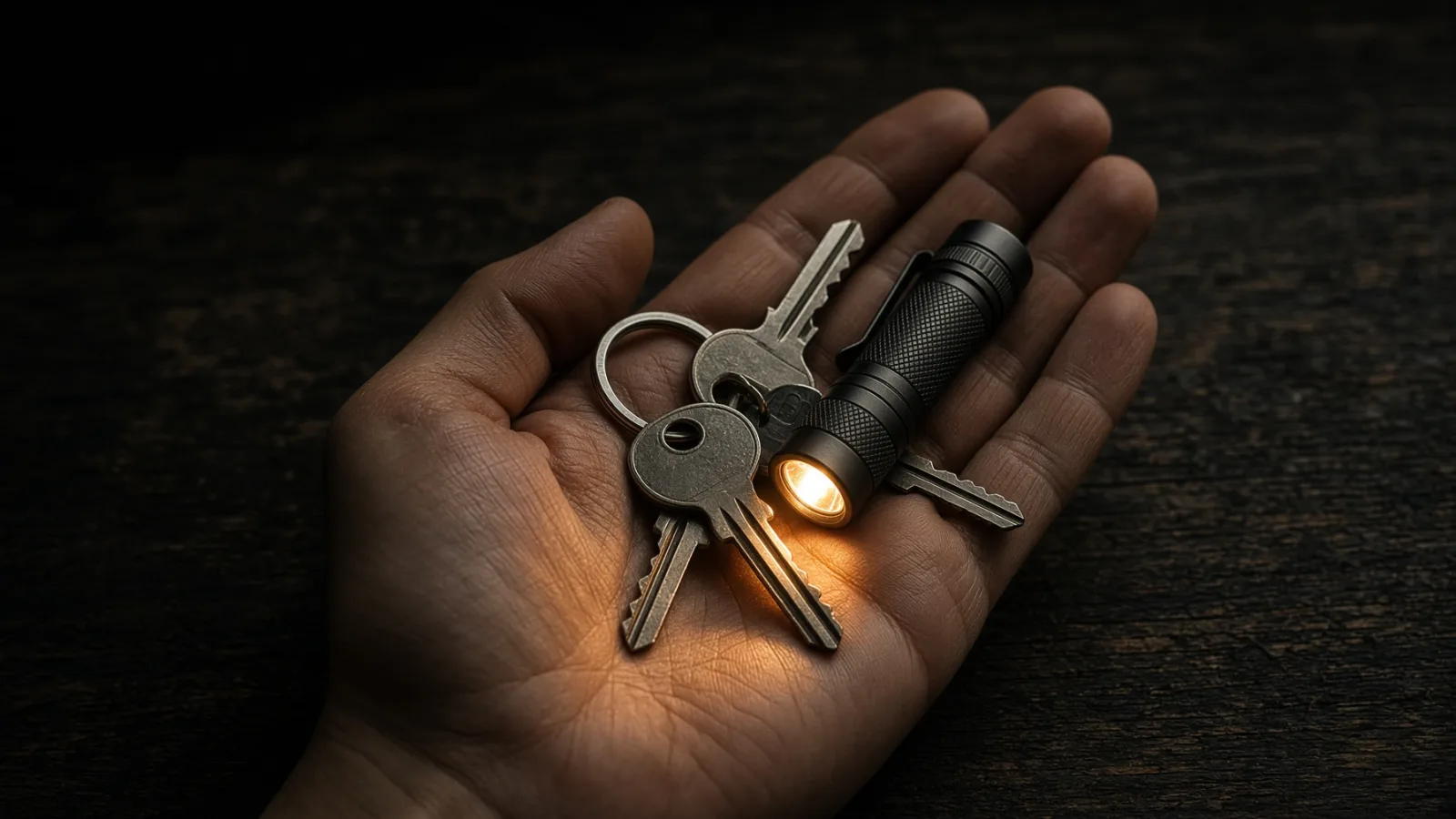
Best Keychain Flashlights (2026): 5 Tiny Lights That Last
Quick answer: The Olight i1R 2 Pro is the one most people should buy — 180 lumens, 11.5 grams, twist-activated so it can’t switch itself on in your pocket. If you want more light, the RovyVon Aurora A5x puts 650 lumens on a keyring. And if you want a light that will still work in five years with zero maintenance, the Streamlight Nano runs on button cells and has nothing to fail.
The keychain flashlight is the only light you’ll genuinely always have. That’s the whole argument for owning one — a 900-lumen pocket rocket in a drawer at home is worth less than 40 lumens in your hand. But keys are a hostile environment: constant abrasion, pocket lint in every port, and a light that gets sat on. Most keychain lights die of neglect rather than use, and that shapes what’s worth buying.
The Three Ways Keychain Lights Fail
They switch on in your pocket. A button-activated light wedged against your leg lights up, drains its tiny cell, and gets hot. You discover it flat exactly when you need it. This is the single biggest argument for twist-activated lights.
The charging port corrodes. A micro-USB or USB-C port riding on your keys collects lint, sweat and grit. Sealed lights with magnetic charging, or lights with no port at all, sidestep this entirely.
The runtime was never real. These lights have cells measured in tens of milliamp-hours. A “180 lumen” keychain light might hold that output for a couple of minutes before stepping down. That’s fine — it’s a find-the-keyhole light, not a search light — but it’s worth knowing before you rely on it.
The Comparison
| Olight i1R 2 Pro | Nitecore TIKI | RovyVon Aurora A5x | Streamlight Nano | ThruNite Ti3 V2 | |
|---|---|---|---|---|---|
| Max output | 180 lm | 300 lm | 650 lm | ~10 lm | 120 lm |
| Weight | 11.5 g | ~18 g | ~24 g | ~9 g | ~15 g (no cell) |
| Power | Built-in, rechargeable | Built-in, USB | Built-in, USB-C | 4× button cell | 1× AAA |
| Activation | Twist | Button | Button | Twist | Twist |
| Extra modes | Low (5 lm) | High-CRI / UV variants | Side LEDs (white/red/UV) | Single output | Firefly to high |
| Standout | Nothing to go wrong | Output per gram | Most light on a keyring | Indestructible | Swappable AAA |
| Weak point | Short runtime | Pocket activation | Port exposure | Genuinely dim | Bulkier |
Sub-$40 lights in this category go on sale constantly and the same model gets revised without a name change. Check the current listing’s specs and price before you buy.
1. Olight i1R 2 Pro — Best Overall
Eleven and a half grams, and it disappears onto a keyring. Two outputs: 5 lumens for reading a label or finding a keyhole without wrecking your night vision, 180 lumens for actually seeing something.
The reason it’s the default pick is the twist activation. Rotate the head to turn it on; there is no button to press itself against your leg. Combined with a body that has no exposed switch to snag, it’s the keychain light least likely to be flat when you reach for it.
Charging is via a small port under a cover. Keep the cover seated and it stays clean.
The catch: at 180 lumens it runs for minutes, not hours. Treat the low mode as the real mode and the high as a burst.
Best for: anyone who wants a keychain light to just work, indefinitely, with no thought.
2. RovyVon Aurora A5x — Most Light on a Keyring
650 lumens from something the size of a AAA battery is faintly absurd, and it’s genuinely useful — this is the keychain light that can substitute for a real flashlight in a pinch.
The Aurora line’s other trick is the secondary side LEDs: a diffused panel in the body that gives you a soft glow, a red mode, or UV depending on variant. The soft glow is the mode you’ll use most — it turns the light into a tiny lantern for reading a map or finding something in a bag without a harsh hotspot. Many versions have a glow-in-the-dark body so you can find the light itself.
USB-C charging, which is the correct port in 2026 — see our USB-C flashlight guide for why it matters more than it sounds.
The catch: it’s a button light, so pocket activation is possible, and the port sees more grit than a sealed design. The 650-lumen mode is a short burst before thermal step-down.
Best for: people who want their keychain light to be a real light.
3. Nitecore TIKI — Best Output Per Gram
Eighteen grams, 300 lumens, and a properly designed multi-mode interface rather than the two-step most keychain lights offer. The clip-on keyring attachment means you can take the light off without wrestling your whole keyring, which is a small thing you’ll appreciate weekly.
Nitecore sells variants worth knowing about: the high-CRI version renders colour accurately (useful for anything you’re actually inspecting), and the UV version is a legitimately handy tool for spotting leaks, checking currency, and finding pet stains.
The catch: button activation, and the built-in cell is small. Pick the variant deliberately — the standard, high-CRI and UV models look identical in listings.
Best for: the specialist variants, and anyone who wants more interface than twist-on/twist-off.
4. Streamlight Nano — Best “Never Think About It” Light
About 10 lumens, roughly 9 grams, machined aluminium, and it runs on four button cells. There is no charging port, no lithium cell to age out, and nothing to configure.
That’s the whole pitch, and it’s a better pitch than the spec sheet suggests. A Nano bought today and forgotten will still light up in five years. Ten lumens is enough for a keyhole, a dropped item under a car seat, or a dark stairwell — which is 90% of what a keychain light gets used for.
Streamlight builds it to their usual standard, and the twist-on head means no accidental activation.
The catch: it is genuinely dim. Do not expect it to do anything at distance.
Best for: a backup light, a spare set of keys, a glovebox, or anyone who resents charging things.
5. ThruNite Ti3 V2 — Best Swappable Battery
The only pick here that runs on a standard AAA, which changes the calculation entirely: when it dies you swap a battery from a TV remote instead of finding a cable. On a long trip or in an emergency kit, that’s worth more than 400 extra lumens.
Output runs from a firefly mode up to 120 lumens, with a twist interface. It’s bulkier than the built-in-cell lights because a AAA is bigger than the cells inside them — that’s the honest trade.
Best for: emergency kits, travel, and anyone who has been burned by a sealed rechargeable dying with no way to revive it.
How to Choose in Thirty Seconds
- Want it to always work with zero effort? Twist-activated, built-in cell: Olight i1R 2 Pro.
- Want it to replace a real flashlight? RovyVon Aurora A5x.
- Want it to still work in five years, unattended? Streamlight Nano.
- Want UV or accurate colour? Nitecore TIKI, correct variant.
- Want to swap a battery instead of charging? ThruNite Ti3 V2.
A note on the money: everything here is under about $40, and the difference between a $12 and a $35 keychain light is real but bounded — better regulation, better waterproofing, a cell that lasts more than a year. The bigger jumps in quality happen further up the price ladder, which we break down in $20 vs $100 flashlight.
Living With a Keychain Light
- Use a quick-release. A small split-ring or quick-detach loop means you can hand someone the light, or use it, without your keys dangling from your wrist.
- Charge it on a schedule, not on demand. These cells are tiny; monthly is about right for a light you use occasionally.
- Check the port cover every few weeks. Lint in a charging port is the most common cause of a keychain light that “won’t charge any more.”
- Don’t rely on it as your only light. It’s a convenience light. Your actual light for a power cut lives elsewhere — see best flashlights for power outages.
- Pair it with a pocket light if you want real capability, not just availability. Best EDC flashlights under $50 covers that tier.
Keychain flashlights are fine in carry-on luggage, incidentally — it’s lighters that have the rules. See can you bring a lighter on a plane?.
FAQ
How many lumens does a keychain flashlight need? Less than you think. 10–50 lumens covers keyholes, footing and dropped objects. 150–300 is genuinely useful. Above that you’re buying burst output that thermal limits will cut short in a body this small.
Are twist or button keychain lights better? Twist, for most people. Button lights switch themselves on in pockets and arrive flat. Buttons are better only if you need fast one-handed access or multiple modes.
How long do keychain flashlight batteries last? On max output, often just a few minutes before stepping down. On low, several hours. Built-in cells also age — expect meaningful capacity loss after two to three years of regular charging.
Are rechargeable or battery keychain lights better? Rechargeable for daily convenience, replaceable cells for reliability over years. If it lives in an emergency kit and gets checked rarely, choose replaceable.
Will a keychain flashlight survive on my keys? The aluminium ones will, cosmetically battered. The failure points are charging ports filling with lint and cells degrading, not the body.
Can I take a keychain flashlight on a plane? Yes — TSA allows flashlights in carry-on and checked bags. Spare lithium cells have to travel in your carry-on, not checked luggage (FAA).