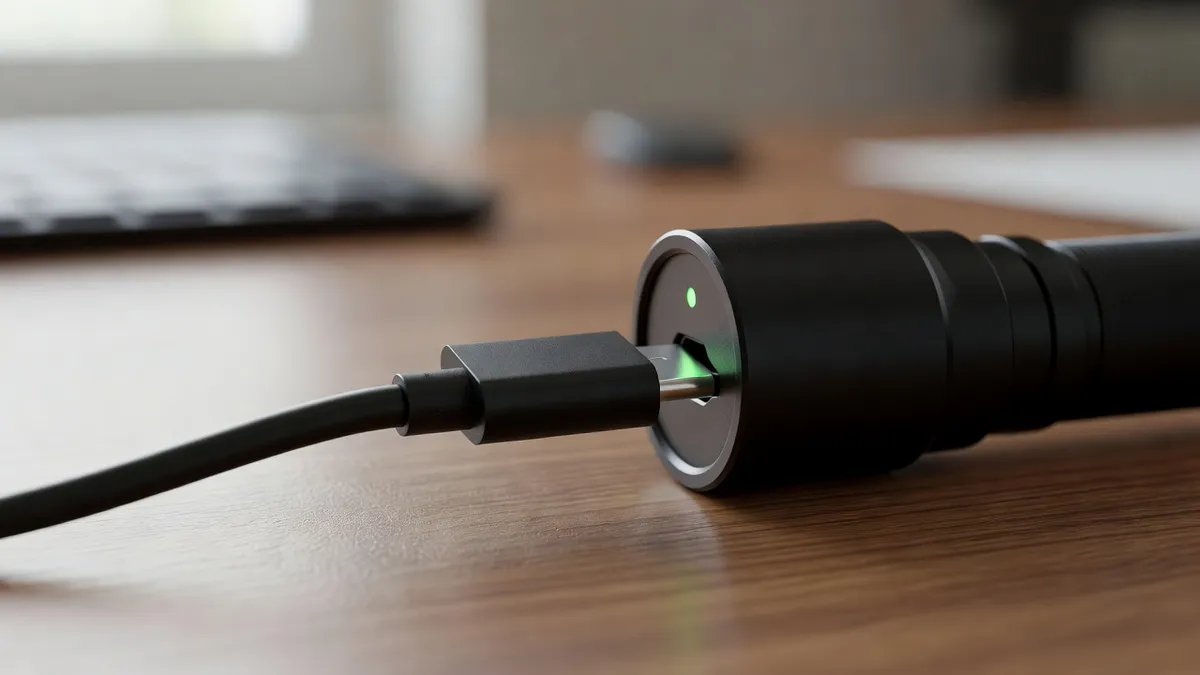
Best USB-C Rechargeable Flashlights (2026): Picks and What to Check
Quick answer: The best USB-C rechargeable flashlight for most people is the Fenix PD36R V2.0: 1,700 lumens, a swappable 21700 battery, 18 W USB-C charging and IP68 sealing. For pocket carry, get the Olight Baton 4 Pro. On a budget, the Wurkkos FC11C charges a standard 18650 over USB-C. Want a light that can also charge your phone? Look at the Fenix LR35R PRO.
Almost every serious flashlight now charges over USB-C, so the port alone no longer separates good lights from bad ones. What matters is the battery type, the real charge time, whether the light runs while plugged in, and how well the port is sealed. Below, seven current lights are compared on their makers’ published specs, followed by what to check on any USB-C torch.
USB-C Rechargeable Flashlights Compared
| Flashlight | Best for | Max output | Beam | Battery | USB-C charge time | Water rating |
|---|---|---|---|---|---|---|
| Fenix PD36R V2.0 | Best overall, camping | 1,700 lm | 396 m | 21700, 5,000 mAh (standard size) | ~2.5 h (18 W adapter) | IP68 |
| Olight Baton 4 Pro | Everyday carry | 1,600 lm | 200 m | Olight 18650, 3,500 mAh (proprietary) | ~3 h 40 min (measured by 1Lumen) | IPX8 |
| Nitecore EDC29 | Most light per pocket | 6,500 lm | 400 m | Built-in, 2,500 mAh | ~1 h 15 min (5 V/2 A) | IP54 |
| Streamlight ProTac 2.0 | Home, car, work | 2,000 lm | 262 m | SL-B50 pack (proprietary) | Not listed | IP67 |
| Fenix LR35R PRO | Max output + power bank | 10,000 lm | 500 m | 2× 21700, 6,000 mAh each | ~4 h (9 V/3 A adapter) | Not listed |
| Wurkkos FC11C | Budget | 1,200 lm | 155 m | 18650 (standard) | Not listed | IPX8 |
| Nitecore TIKI | Keychain backup | 300 lm | 71 m | Built-in, 130 mAh | ~1 h 20 min | IP66 |
Charge times are the makers’ figures with the adapter they name, except the Baton 4 Pro, which is 1Lumen’s measured time on a USB-C to USB-C charger. Prices move often, so check the current listing.
Best Overall (and for Camping): Fenix PD36R V2.0
The PD36R V2.0 gets the USB-C details right. Fenix rates it at 1,700 lumens and a 396 m beam, with up to 482 hours on its lowest mode from the included 5,000 mAh 21700 battery. The USB-C port accepts up to 18 W, and Fenix puts a full recharge at about 2.5 hours with an 18 W or stronger adapter. It’s IP68-rated and weighs 167 g with the battery, so it rides in a jacket pocket or the included holster.
Two catches, both in Fenix’s manual. Only the lowest (Eco) mode works while the light is charging, and the charging and battery-level features are designed around Fenix’s own ARB-L21 cells. Fenix lists other 21700 Li-ion cells as “caution” and unprotected cells as banned.
For camping and blackouts, a tail switch, a standard-size battery and a very long low mode are hard to beat; it’s also the handheld in our power outage flashlight guide. Check the Fenix PD36R V2.0 on Amazon →
Best USB-C EDC Flashlight: Olight Baton 4 Pro
Olight rates the Baton 4 Pro at 1,600 lumens, a 200 m beam and 114 g, and it charges two ways: Olight’s magnetic MCC cable or a standard USB-C port. The port sits under a sliding metal cover near the tail that opens when you twist a ring, according to 1Lumen’s review, so there’s no rubber flap to tear. 1Lumen measured about 3 hours 40 minutes for a recharge on a USB-C to USB-C charger, and Olight rates the light IPX8.
The trade-off is the battery. The 3,500 mAh 18650 is Olight’s own design, and 1Lumen notes you’re limited to Olight’s proprietary cells, so a generic 18650 from a drawer won’t work. It also can’t charge other devices. If you want more reach in the same size, the Baton Ultra is rated at 1,800 lumens and a 300 m throw at 113 mm and 115 g.
How Olight’s approach compares with the other big names is covered in Olight vs Fenix vs Streamlight. Check the Olight Baton 4 Pro on Amazon →
Brightest Pocket Light: Nitecore EDC29
The EDC29 is a flat stainless-steel light that Nitecore rates at 6,500 lumens and 400 m from two LEDs, at 160 g. An OLED screen shows the output, remaining runtime and battery voltage, and Nitecore says it recharges in about 1 hour 15 minutes from a 5 V/2 A adapter.
Know what you’re buying, though. The battery is a built-in 2,500 mAh pack, so you can’t swap it when it wears out. The IP54 rating means splash resistance, not submersion. And Nitecore says the output is automatically reduced during long high-brightness use to manage heat, so 6,500 lumens is a burst, not a working level. For most jobs a few hundred lumens is plenty; see how many lumens a flashlight should have. Check the Nitecore EDC29 on Amazon →
Best for Home, Car and Work: Streamlight ProTac 2.0
The ProTac 2.0 is the simple option. Streamlight rates it at 2,000 lumens and a 262 m beam, IP67 (waterproof to 1 m for 30 minutes) and tested for 2 m drops. The tail switch runs one of three programs you choose: High/Strobe/Low, High only, or Low/Medium/High. Someone grabbing it from a kitchen drawer in the dark won’t have to learn a menu.
Its SL-B50 battery pack charges over USB-C either inside the light or on its own, so you can charge a spare pack while using the light. The pack is Streamlight-specific, and runtimes are shorter than the Fenix’s: 2.5 hours on High and 25 hours on the 100-lumen Low. At 234 g, it’s also noticeably heavier than the 167 g Fenix. Check the Streamlight ProTac 2.0 on Amazon →
Most Output, Plus a Power Bank: Fenix LR35R PRO
The LR35R PRO is a compact searchlight. Fenix rates it at 10,000 lumens and 500 m, with separate spot and flood beams, red and UV modes, and two 6,000 mAh 21700 batteries. At 457 g with batteries, it belongs in a pack or a truck, not a pocket.
It’s the only light in this guide sold as a power bank: its USB-C port handles 18 W charging and discharging. Fenix says it recognizes USB PD fast chargers as well as standard 5 V adapters and recharges in about 4 hours on a 9 V/3 A adapter. While it’s charging, or charging something else, the white beams are limited to 200–900 lumens. Fenix’s product page doesn’t list a water rating, so check the manual before you count on it in a downpour. More big-output options are in our brightest affordable flashlights roundup. Check the Fenix LR35R PRO on Amazon →
Best Budget USB-C Flashlight: Wurkkos FC11C
The FC11C is one of the cheapest ways into a USB-C light that runs on a standard cell. Wurkkos rates it at 1,200 lumens and 155 m, with a 95 CRI Nichia 519A LED (4000K or 5000K) that shows colors accurately, IPX8 sealing, a magnetic tail, and an 18650 that charges inside the light over USB-C. Turbo steps down after 90 seconds to control heat. It usually sells for well under $50.
For a keychain backup, the Nitecore TIKI weighs 12 g, puts out 300 lumens and recharges over USB-C in about 1 hour 20 minutes. Its 130 mAh built-in battery is tiny, so treat it as a spare, not a main light (check the TIKI on Amazon). More sub-$50 picks, including the Sofirn SC31 Pro and Wurkkos TS10 V2, are in our best EDC flashlights under $50. Check the Wurkkos FC11C on Amazon →
What Actually Matters in a USB-C Rechargeable Flashlight
The port itself is standard now. These details decide whether a light is still useful in five years.
Standard cell, proprietary cell or built-in pack
This is the biggest decision, and the spec sheet often buries it.
- Standard 18650 or 21700 cell, charged in the light (PD36R V2.0, FC11C). You can carry a charged spare and swap it in seconds, and a worn-out cell costs a battery, not a flashlight. Use protected cells of the size the maker specifies.
- Proprietary cell or pack (Baton 4 Pro, ProTac 2.0). Replaceable, but only from the maker, and only while they still sell it.
- Built-in pack (EDC29, TIKI). Allows the thinnest, lightest designs, but you can’t replace the battery yourself.
Manufacturers typically rate consumer lithium-ion batteries for 300 to 500 full charge cycles. That’s years of weekly charging, but every cell fades eventually, and then the battery type decides whether you replace a cell or the whole light.
Charge time depends on the charger
Makers quote charge times with a specific adapter. The PD36R’s 2.5 hours assumes an 18 W or stronger fast charger, the EDC29’s 1 hour 15 minutes assumes 5 V/2 A, and the LR35R PRO’s 4 hours assumes a 9 V/3 A USB PD adapter. On a laptop port or an old 5 V phone brick, expect it to take longer. Bigger batteries take longer to fill, so compare charge time against capacity.
Can it run while charging?
Many lights can’t, or only on low. The PD36R V2.0 allows only its Eco mode while plugged in, and the LR35R PRO caps output at 200–900 lumens. If you want a light that doubles as a plugged-in work lamp, find this line in the manual before you buy.
Power bank (reverse charging)
A few lights can push power out of their USB-C port to charge a phone. It’s handy in an outage, but every bit of charge you give the phone is light you don’t have later. For a real emergency kit, a dedicated power bank is still the better tool.
USB-C to USB-C charger compatibility
A USB-C port doesn’t guarantee a light will charge from a USB-C to USB-C cable. Some lights, usually cheap or older ones, only charge from a USB-A to USB-C cable. Check the manual or a detailed review; 1Lumen’s Baton 4 Pro review, for example, lists USB-C to USB-C charging as its own line (it passes). If a light won’t charge from your USB-C brick, try an A-to-C cable before assuming it’s broken.
Water resistance with a charging port
The port is usually the weak point in a sealed light, so look at how it’s covered. The PD36R uses an anti-dust cover that Fenix tells you to close after charging, and the Baton 4 Pro hides its port under a sliding metal cover. Then read the rating correctly. IP67/IPX7 means immersion to about 1 m for 30 minutes, and IPX8 means deeper or longer, as specified by the maker. IP54 and IP66 (the EDC29 and TIKI) cover rain and splashes, not a swim. Every rating assumes the cover is fully closed.
Battery care
Lithium-ion has no memory, so top the light up whenever it’s convenient. Battery University notes that partial charges are fine and periodic full discharges aren’t needed. Heat and long stretches at 100% age a cell fastest, so keep the light off a hot dashboard. For a drawer light, Fenix recommends recharging every four months.
FAQ
Are USB-C rechargeable flashlights worth it? For a light you use every week, yes. You charge it with the same cable as your phone and stop buying disposable batteries. For a light that sits unused for years, pick one with a standard, replaceable cell and put a reminder on your calendar to top it up.
Can I charge a USB-C flashlight with my phone charger? Usually, yes. A USB-C phone charger works with most current lights, and a higher-watt charger is fine because the light only draws what it needs. Lights that support fast charging, like the PD36R V2.0 at up to 18 W, fill faster on a stronger adapter. If a light won’t charge from a USB-C to USB-C cable, try a USB-A to USB-C cable and check the manual.
How long does a USB-C flashlight battery last? Per charge, it depends on the mode: the ProTac 2.0 runs 2.5 hours on High, while the PD36R V2.0 lasts up to 482 hours on its lowest mode. Over its life, manufacturers typically rate consumer lithium-ion batteries for 300–500 full cycles, which is years of normal use.
Can I replace the battery in a USB-C flashlight? It depends on the design. Lights that use standard 18650 or 21700 cells, like the PD36R V2.0 and FC11C, take a new cell in seconds. Proprietary cells (Olight) and packs (Streamlight) are replaceable but must come from the maker. Built-in packs, like the EDC29 and TIKI, aren’t user-replaceable.
Are USB-C flashlights waterproof with the charging port? Many are, as long as the port cover is fully closed. IP67/IPX7 and IPX8 lights are rated for immersion, while IP54 and IP66 lights such as the EDC29 and TIKI are only rated for rain and splashes. Let a wet port dry before plugging in.
Is magnetic charging better than USB-C? Magnetic charging, like Olight’s MCC, is quicker to connect and has no port to seal, but the cable is proprietary, so losing it on a trip is a problem. USB-C works with cables you already own. The Baton 4 Pro has both, so you’re covered either way.