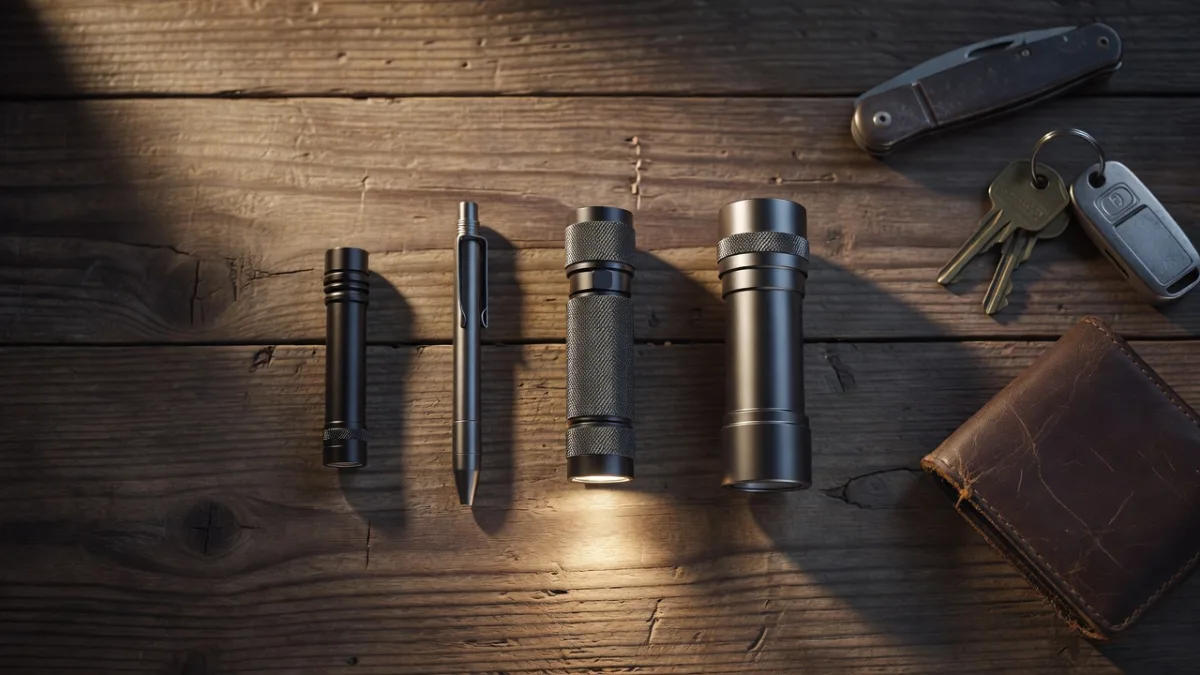
Best EDC Flashlights Under $50 (2026): 4 Pocket Lights Worth Carrying
Quick answer: Under $50 you can have a genuinely excellent pocket light — you just have to pick which compromise you want. Want the most light and runtime? The Sofirn SC31 Pro (2,000 lumens, 18650, USB-C). Want something you’ll actually forget is in your pocket? The Wurkkos TS10 V2 (32 g, 90 CRI). Want zero menus and zero fuss? The Olight i5R EOS (350 lumens, two modes, one button).
The sub-$50 band changed more than any other over the last few years. Onboard USB-C charging, 90+ CRI emitters, and IP68 sealing all used to be $80+ features; today they’re routine at half that. What you’re still paying up for above $50 is beam quality at distance, warranty support, and machining polish — not raw capability. We break that trade-off down in detail in $20 vs $100 flashlight.
How to Choose: Three Questions, Not Twenty
1. What battery are you willing to carry? This decides the light’s size more than anything else. An 18650 cell means a light about the length of a marker pen and real runtime. A 14500 (AA-sized lithium) halves the bulk and roughly halves the runtime. There is no third option worth having at this price.
2. Do you want a menu or a switch? Anduril 2 firmware — standard on Sofirn and Wurkkos — gives you ramping, strobe, lockout, battery check, and a genuinely deep configuration tree. Enthusiasts love it. If the phrase “hold from off for 3 clicks” makes you tired, buy a two-mode light instead and never think about it again.
3. How often will you actually charge it? Onboard USB-C is the single most useful feature at this price. A light you top up from the same cable as your phone gets carried; one that needs a separate cell charger ends up in a drawer. See our USB-C flashlight guide for why.
The Comparison
| Sofirn SC31 Pro | Wurkkos TS10 V2 | Olight i5R EOS | Streamlight MicroStream USB | |
|---|---|---|---|---|
| Max output | 2,000 lm | 1,400 lm | 350 lm | 250 lm |
| Emitter | SST40, 6500K | 3× CSP, 90 CRI (4000K or ~5800K) | — | — |
| Battery | 18650 | 14500 (not AA) | 14500, built in | Li-ion, built in |
| Charging | USB-C onboard | USB-C onboard | USB-C onboard | micro-USB (pull bezel) |
| Water rating | IPX8 | IP68 | IPX8 | IPX4 |
| Size / weight | ~4.6 in, ~2 oz (no cell) | 71.5 mm, 32 g (no cell) | 95.4 mm, 2.12 oz | 3.87 in |
| Interface | Anduril 2 | Anduril 2 | 2 modes, tail switch | 2 modes, tail switch |
| Best for | Most output + runtime | Pocketability + color accuracy | Simplicity | Clipping to a cap or pocket |
Prices in this band move constantly — sale cycles regularly swing these lights by 30–40%. Treat “under $50” as a category, and check the current listing before buying.
1. Sofirn SC31 Pro — Best Overall Under $50
This is the light the enthusiast forums have defaulted to for years, and the reason is unglamorous: it does everything competently and costs almost nothing. The SST40 emitter pushes 2,000 lumens with about 226 m of throw, the 18650 cell charges over USB-C right in the light, it’s rated IPX8, and it runs full Anduril 2.
The runtime numbers are what actually matter for carry. Turbo is a party trick that thermally steps down within minutes; the useful figures are 900 lumens for roughly 2 hours 10 minutes on High and 300 lumens for about 5 hours 50 minutes on Medium. That medium mode is more light than most people ever need and it lasts an evening — the same logic we apply in the power outage kit guide.
The cost is bulk. An 18650 tube at ~4.6 inches rides fine in a jacket or bag, less happily in jeans. And Anduril will confuse anyone who doesn’t want to learn it. Check the Sofirn SC31 Pro →
2. Wurkkos TS10 V2 — Best If You Want to Forget It’s There
32 grams without a cell, 71.5 mm long, 21 mm head. This is a light that disappears into a coin pocket, and it still does 1,400 lumens from three CSP emitters — with 90 CRI, which is the spec nobody advertises and everybody notices. High-CRI light renders colour honestly: skin, wiring insulation, wood grain, and blood all look like themselves rather than washed-out grey-blue. Once you’ve carried a 90 CRI light, a cheap cool-white one looks broken. It’s IP68, runs Anduril 2, and adds RGB aux LEDs under the optics so you can find it in the dark.
Two honest warnings. First, it does not run on AA batteries despite being AA-sized — it needs a 14500 lithium cell, and feeding it an alkaline AA will not work properly. Second, a 14500 in a light this small means turbo is brief; treat the high modes as bursts, not settings.
Pick the 4000K version if you’re choosing. Neutral white is easier on the eyes and better outdoors. Check the Wurkkos TS10 V2 →
3. Olight i5R EOS — Best for People Who Hate Flashlight Menus
Some people want a flashlight, not a hobby. The i5R EOS is a 350-lumen, two-mode, tail-switch light in an AA-sized body with the 14500 cell and USB-C charging built in. Click for high, half-press or click again for low. That’s the entire manual.
Its numbers look modest next to the others and that’s mostly framing: 350 lumens with a 64 m throw covers a driveway, a crawlspace, a dog walk, and a dropped key — the real jobs. What sells it is the low mode: 15 lumens for 37 hours, which means it is genuinely still working two nights into an outage while the turbo-chasing lights are dead. High runs 350 lumens for about 10 minutes then holds 150 lumens for roughly another 170 minutes.
At 2.12 oz and 95.4 mm it’s a comfortable pocket carry. Olight’s proprietary charging on other models annoys people; this one is straightforward. Check the Olight i5R EOS →
4. Streamlight MicroStream USB — Best Clip-On Utility Light
A different shape of tool: a pen-thin 3.87-inch light with a two-way pocket clip that also grips a cap brim, turning it into an improvised headlamp. 250 lumens for 1.5 hours on high, 50 lumens for 3.5 hours on low, a 68 m beam, machined aluminium, and Streamlight’s reputation for lights that survive being dropped on concrete by people who do that for a living.
Be clear about the compromises before buying: it charges over micro-USB, not USB-C, via a bezel you pull open — an annoyance in 2026 — and it’s rated IPX4, meaning splash resistance only. Don’t take it swimming. If Streamlight’s build quality is the appeal, we compared the brand against its rivals in Olight vs Fenix vs Streamlight. Check the Streamlight MicroStream →
What to Skip in This Price Band
- “100,000 lumen” listings. No pocket light makes five figures of lumens. Inflated marketing claims are the single most reliable sign of a light whose other specs are also fiction — more red flags in what to look for in a good LED flashlight.
- Lights with a sealed, unnamed battery. When the cell dies in two years the whole light is landfill.
- Zoomable “tactical” kits with a plastic bezel and a bundled charger. The zoom mechanism kills the beam and breaks first.
- Anything without a stated water rating. IPX4 is a real answer; silence is not.
FAQ
How many lumens do I need for everyday carry? Far fewer than the box art suggests. 200–400 lumens handles almost every real EDC task; 1,000+ is for reassurance and the occasional outdoor sweep. Runtime at usable output matters more than peak — see our lumens guide.
Is 18650 or 14500 better for EDC? 18650 for runtime and output, 14500 for carry comfort. If the light lives in a bag, take 18650. If it lives in your pocket, take 14500 — the light you actually carry beats the brighter one you leave at home.
What is high CRI and should I pay for it? CRI measures how accurately a light renders colour, on a 100-point scale. 90+ looks natural; typical budget emitters sit around 70 and make everything look flat and blue. It costs a small amount of peak brightness. For anyone inspecting, repairing, or photographing anything, it’s the best upgrade at this price.
Do I need Anduril? No. It’s powerful and free, but a two-mode light with a good low mode covers 95% of use. Buy the interface you’ll enjoy, not the one with the longest feature list.
Is it worth spending more than $50? Only for specific things: serious throw, certified impact and submersion ratings, or a warranty you’ll actually use. Capability-per-dollar peaks right about here — the full argument is in $20 vs $100 flashlight. If the job is weather and drops rather than pocket carry, see most durable flashlights.
What if I won’t carry something this size? Then buy smaller rather than buying nothing — a light on your keys beats a better light in a drawer. See best keychain flashlights for the sub-25 gram tier, and lumens vs candela vs beam distance for how to read the specs on anything you’re comparing.