Best Candle Lighters: Electric, Butane & Long-Reach Compared
Quick answer: For most homes, a rechargeable electric candle lighter with a long flexible neck is the one to buy — no fuel to replace, no flame to tip, and it reaches down into jar candles that a pocket lighter can’t touch. If you light a fireplace or a gas grill as well as candles, a refillable long-reach butane lighter is the better all-rounder, because a real flame works at any angle and in a draught.
Candle lighters look like a solved problem until you own a deep jar candle. Then the specifics start to matter: how far the neck actually reaches, whether the thing works pointed downward, and whether you can refill or recharge it rather than buying another one in six months.
This guide covers the home candle case specifically. For arc technology itself — how the plasma ignition works, and which arc lighters suit camping and emergency kits — see the arc lighter guide, which goes deeper on that one category.
The Three Types (and Who Each One Suits)
1. Electric arc candle lighters — best for most homes
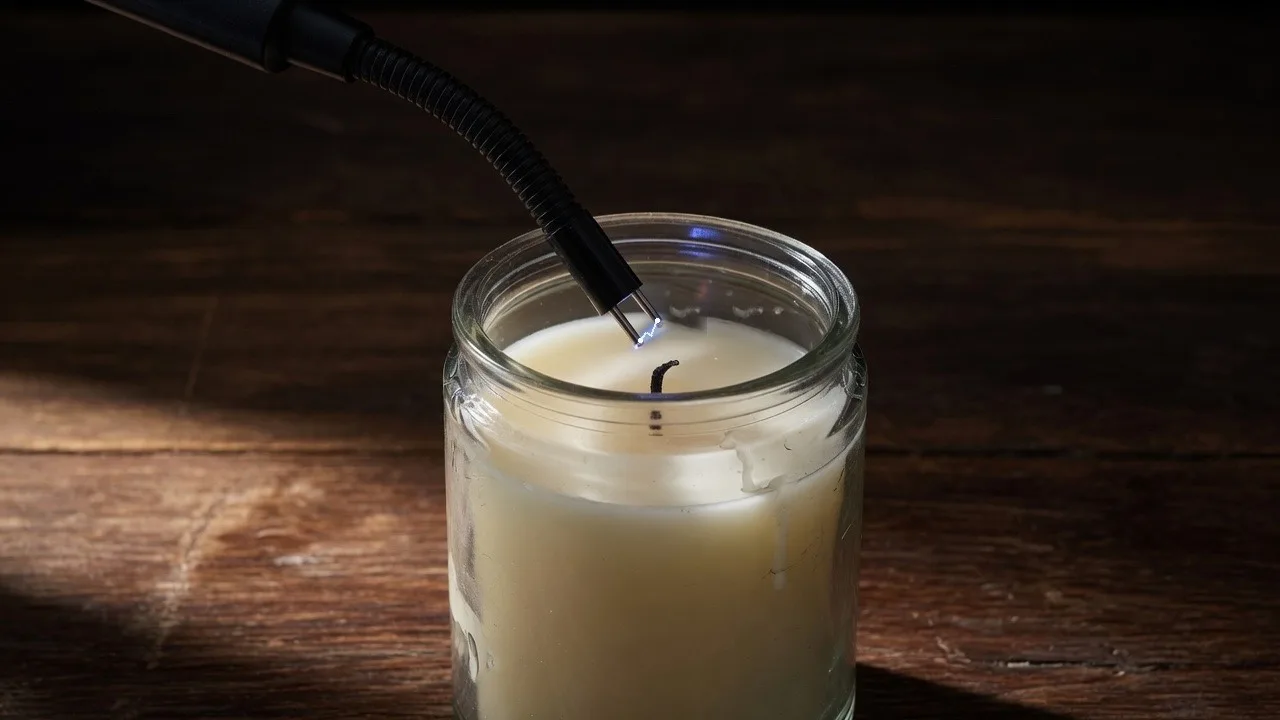
An arc lighter creates a small electrical arc between two contacts instead of burning fuel. There’s no flame to blow out, nothing to spill, and you recharge over USB rather than buying butane. On a long flexible neck, this is close to ideal for candles: you can push the tip right down to a recessed wick and the arc doesn’t care about the angle.
Two things to know before you commit. The arc gap is narrow, so it lights wicks and tinder well but is fiddly on a wide or badly trimmed wick. And nearly all of them cut out after about ten seconds to protect the circuit — fine for candles, less fine if you’re coaxing a stubborn fireplace. Browse electric candle lighters.
2. Refillable butane utility lighters — best if you light more than candles
A butane utility lighter gives you an adjustable real flame on a long wand. That flame keeps burning as long as you hold the trigger, works in a draught, and lights a fireplace, a pilot light, a gas grill or a stove burner as happily as a candle. Refillable models take standard butane, so the running cost is close to nothing and you’re not replacing the tool.
The trade-off is that a flame wants to point upward. Hold most butane wands inverted for long and the flame gets unreliable — worth checking whether a model advertises angled or 360-degree operation if you have candles in awkward spots. If your gas stove igniter has died, this is also the tool that saves you lighting the burner with matches. Browse refillable utility lighters.
3. Disposable long-reach lighters — best for occasional use
The familiar plastic wand lighter. Cheap, available everywhere, and completely adequate if you light a candle at dinner a few times a month. You cannot refill them and you cannot recharge them, so they’re the most wasteful option per light — but they’re also the only one you can buy at the corner shop at short notice. Browse long-reach lighters.
What to Look For
Neck length and flexibility. This is the single specification that decides whether a candle lighter is pleasant or annoying to own. Measure your deepest jar candle before buying. A rigid short neck cannot reach a wick that has burned down inside a tall vessel, and that is exactly when you most need the tool.
Child-resistant lock. Any lighter kept in a kitchen drawer should have one. In the US, CPSC rules require multi-purpose lighters (the long-reach kind used for candles and grills) to have a child-resistant mechanism that resets after every use. It’s a small daily inconvenience and the reason the drawer is safe.
Battery indicator (electric models). Without one you discover the battery is flat at the moment you want light. A four-LED indicator is more useful than a single blinking light.
Refillable or rechargeable. Both beat disposable on cost and waste. Which one you prefer mostly comes down to whether you’d rather keep a butane can or a USB cable to hand.
Windproof behaviour. Arc lighters are genuinely unaffected by wind because there’s no flame. A butane flame can be blown out, which matters on a patio or near an open window.
A stable base or hanging loop. Minor, but a lighter that stands up or hangs by the fireplace is a lighter you can find.
Electric vs Butane for Candles
| Electric arc | Refillable butane | Disposable | |
|---|---|---|---|
| Running cost | USB charge | Butane refills | New lighter each time |
| Works upside down | Yes | Often poorly | Often poorly |
| Windproof | Yes | No | No |
| Lights a fireplace | Struggles | Yes | Yes |
| Continuous burn | ~10s cutoff | As long as held | As long as held |
| Best for | Jar candles, indoors | Mixed household use | Occasional use |
If you only light candles, the electric arc wins on convenience. The moment a fireplace or grill enters the picture, butane’s sustained, angle-tolerant flame is worth more than the recharging convenience.
When the Lighter Isn’t the Problem
Before blaming the tool, check the candle. A wick trimmed too short sits below the wax line and won’t catch no matter what you hold to it — the fix is to pour off or scrape away a little of the surrounding wax to expose the wick again, not a hotter flame. A wick left too long produces a large smoky flame and a mushroomed tip that resists lighting; about a quarter of an inch is the usual advice.
Tunnelling causes the same complaint. If a candle has burned a narrow shaft down the middle, the wick ends up recessed deep inside a wax wall, and only a long flexible neck will reach it at all. That’s the situation that sells more candle lighters than any other, and it’s worth knowing it’s a candle-burning issue rather than a lighter issue — the first burn should be long enough to melt the wax all the way to the edge.
Safety and Storage
The candle is a bigger fire risk than the lighter. US fire departments respond to an estimated 5,894 home fires a year started by candles, and over half begin when something flammable sits too close to the flame, so keep lit candles well clear of curtains and décor.
Keep any lighter away from heat sources and out of direct sun — that applies to butane and to lithium batteries alike, for different reasons. Store them where children can’t reach them even with the child lock engaged, and don’t leave a lighter sitting on a warm hob or a sunny windowsill. If a butane lighter stops working after a refill, it’s usually an air lock rather than a fault; bleeding and refilling it properly fixes most of them.
Travelling with one is a separate question with its own rules — see what you can take on a plane before packing.
FAQ
Are electric candle lighters any good? For candles, yes — the flexible neck and flameless arc suit jar candles better than any flame lighter. They’re weaker for fireplaces and anything needing a sustained burn, because of the automatic cutoff.
How long does a candle lighter last? A rechargeable one lasts as long as its battery holds a useful charge, typically several years of household use. Refillable butane models can last far longer, since the fuel is replaceable and there’s no battery to degrade. Disposables are the shortest-lived by design — the fuel-life question covers how butane capacity actually translates into lights.
Can you refill a candle lighter? Refillable butane models, yes, using standard butane through the valve in the base. Electric models aren’t refilled but recharged. Disposables are neither.
Which is safer around children? Any model with a working child-resistant lock, stored out of reach. Electric arc lighters have the modest advantage of no fuel and no open flame, but a lock and sensible storage matter far more than the technology.
Do candle lighters work in wind? Arc lighters do, because there’s no flame to extinguish. Butane and disposable flames do not, reliably — relevant for patio candles and draughty rooms.
Bottom line: buy the electric arc if candles are the job, and the refillable butane if the same tool has to light a fire pit on Saturday. Either beats replacing a disposable every few months. Compare current candle lighters on Amazon →