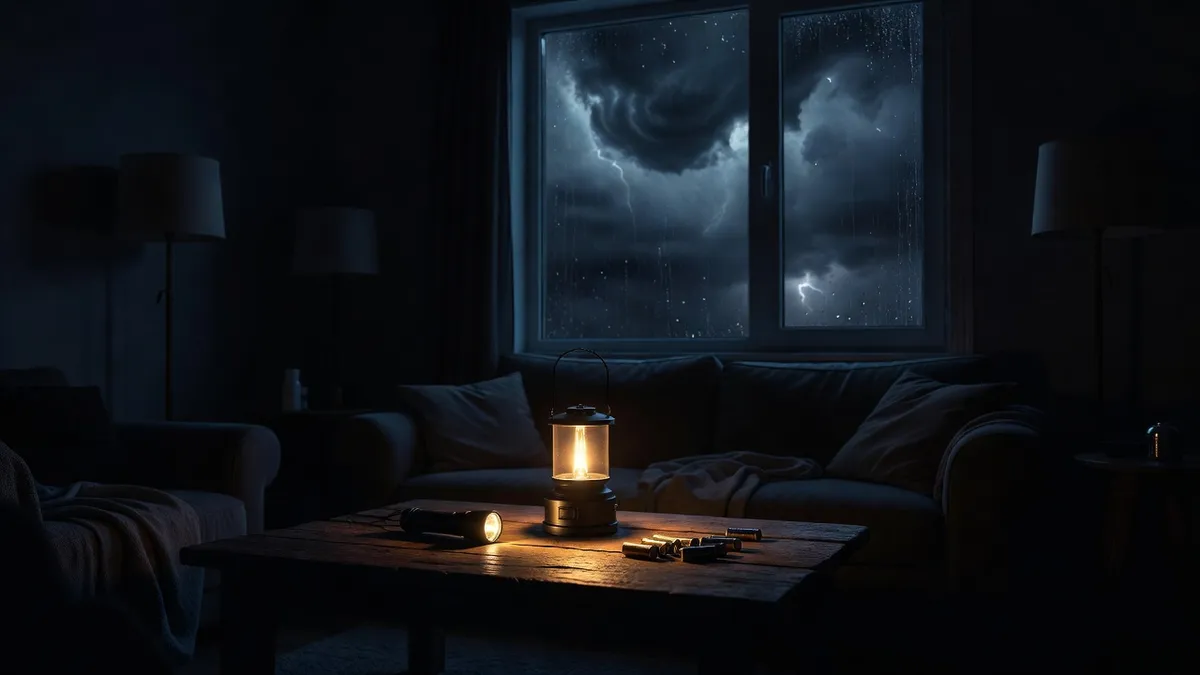
Best Flashlights for Power Outages & Hurricane Season (2026)
Quick answer: For a blackout you want runtime, not lumens — a light that does 100–300 lumens for days beats a 3,000-lumen monster that dies in an hour. The ideal kit is three layers: a lantern for the room (browse LED lanterns), a headlamp per person for moving around hands-free (browse headlamps), and one strong handheld like the Fenix PD36R for checking the breaker box, the yard, and the storm damage.
Hurricane season peaks in late August and September, and the time to build this kit is before the forecast has a cone on it — emergency lights sell out in the 48 hours before landfall, every year, everywhere.
Why Your Phone Flashlight Isn’t a Plan
The phone light is fine for finding the real flashlight — and terrible for everything else. It drains the one battery you need most for emergency calls and outage updates, it can’t be set down to light a room, and multi-day outages (Ida left people dark for over a week) turn “my phone is my flashlight” into “my phone is dead.” Rule one of outage lighting: never spend phone battery on light.
The Three-Layer Blackout Kit
Layer 1: A lantern for the room
A lantern lights a whole kitchen or bedroom at once and sits on the table while everyone eats, plays cards, or waits it out. Look for: 360° output with a low mode in the 50–100 lumen range (that’s genuinely enough), 100+ hours of low-mode runtime, and AA/D-cell or USB-C power. Collapsible models store flat in the kit between storms. Check LED lanterns on Amazon →
Layer 2: A headlamp per person
The most underrated outage tool. Cooking on a camp stove, taping windows, checking the sump pump, walking the dog — everything during an outage needs two hands. A basic 200–400 lumen headlamp with a red mode (preserves night vision, doesn’t wake the household) costs little and changes everything. One per family member; they’re no fun to share. Models with a AAA fallback are the smart pick here, for the same reason they win on long trips — see our best headlamps guide. Check headlamps on Amazon →
Layer 3: One serious handheld
For everything outside the house: downed branches, the breaker panel, signaling, walking a dark street. This is where our usual advice applies — see things to look for in a good LED flashlight — but for storms, weight waterproofing (IPX7+) and a low mode with 100+ hour runtime over maximum lumens. Our pick is the same light we recommend everywhere: the Fenix PD36R V2.0 — 1,700 lumens when you need power, up to 482 hours on its 5-lumen Eco mode when you need endurance, IP68, USB-C. A budget tactical light covers the same role for less.
The Battery Strategy (This Is the Part People Get Wrong)
| Approach | Strength | Weakness | Role in the kit |
|---|---|---|---|
| Rechargeable (USB-C) | Cheap to run, always topped up | Dead is dead when the grid’s down | Primary lights |
| AA / D alkaline | Shelf-stable ~10 years, buy anywhere | Weaker output, single-use | Backup lights + lantern |
| Power bank | Recharges lights AND phones | Needs discipline to keep charged | The bridge between them |
The resilient setup mixes chemistries: rechargeable primaries, alkaline-powered backups, and a high-capacity power bank (or two) kept charged. When a storm enters the forecast, top up every rechargeable device that night — not when the wind starts. Spare alkalines live in the kit, not in the kitchen drawer where they wander off. For why we prefer USB-C charging across the board, see the USB-C flashlight guide.
Fire, Candles, and the Old Ways
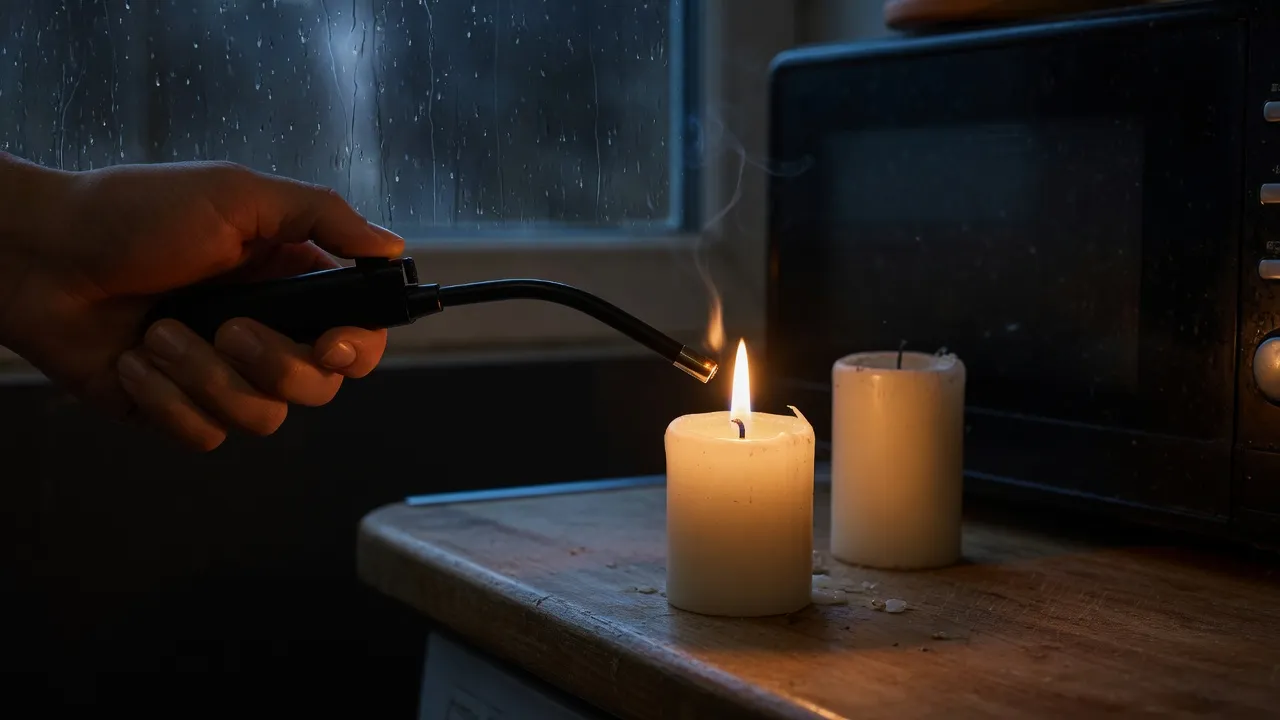
Candles are a real fire risk in an outage: the National Candle Association, citing NFPA data, says more than 20% of candle fires involving fatalities happen during a loss of power, and the Red Cross’s advice is simply to use flashlights, not candles. If you use them anyway, never leave one burning unattended, and put them in real holders away from curtains. The safer modern equivalent for ambiance and ignition both: an arc lighter for the gas stove (most gas ranges light manually in an outage — here’s how to light a gas stove manually) and LED lanterns for the light. If you do stock a lighter in the kit, a fresh BIC keeps for years, as we covered in Zippo vs BIC vs arc.
The 10-Minute Storm-Kit Checklist
- 1 lantern per main room (with its batteries stored beside it, not inside it)
- 1 headlamp per person + red mode
- 1 waterproof handheld (charged monthly)
- Spare alkalines: at least 8×AA / 4×D in the kit box
- 1–2 power banks, topped up on the first of every month
- Arc lighter or fresh BIC for the stove
- Everything in ONE labeled box the whole family can find in the dark
FAQ
How many lumens do I need in a power outage? Less than you think: 50–100 for a room, 200–400 for moving around, 1,000+ only for outdoor checks. Runtime is the spec that matters — our lumens guide has the full breakdown.
Are solar lights worth it? As a backup layer, yes — a small solar lantern recharges on any windowsill. As the primary, no; storm weeks are cloudy weeks.
Should I buy a generator instead? Different problem. A generator runs the fridge; you still need portable light in every room and pocket. Build the light kit first — it costs a tenth as much.
How often should I check the kit? Test lights and rotate batteries twice a year — the classic trick is doing it when the clocks change.