The Best Camping Flashlights of 2026: Picks by Trip Type
Quick answer: For most campers, the best camping flashlight is the Fenix PD36R V2.0: 1,700 lumens, a 5-lumen Eco mode that runs up to 482 hours, IP68 sealing and a swappable 21700 battery. Backpackers should carry the 55 g Acebeam Pokelit AA, which also runs on one AA. The Acebeam TAC 2AA doubles as a table lantern, and the Nitecore P20iX takes CR123A backups for emergencies.
This page is the shopping list: specific flashlights, matched to the kind of trip. Not sure whether you need a headlamp, a lantern or a handheld at all? Start with what is the best torch for camping?, which explains which type of light does which job, then come back here for the model.
How we picked: we haven’t bench-tested these lights. Each one is compared on its maker’s published specs, linked in its section, with most weight on the numbers that decide a camping trip: low-mode runtime, battery type, weight and water rating.
The Best Camping Flashlights at a Glance
| Flashlight | Best for | Max output | Low mode (runtime) | Battery | Weight | Water rating |
|---|---|---|---|---|---|---|
| Fenix PD36R V2.0 | Car camping, all-round | 1,700 lm | 5 lm Eco (up to 482 h) | 21700 Li-ion, USB-C | 167 g with battery | IP68 |
| Fenix PD36R Pro | Most output | 2,800 lm | Up to 42 h | 21700 Li-ion, USB-C | 169 g with battery | Submersible to 2 m |
| Acebeam Pokelit AA | Backpacking | 550 lm | 5 lm (58 h) | 14500 Li-ion with USB-C, or 1× AA | 54.6 g | IP68 (2 m) |
| Acebeam TAC 2AA | Around camp, lantern use | 1,600 lm (630 on NiMH AAs) | 1.6 lm (94 h); 35 lm (36 h) | Acebeam Li-ion with USB-C, or 2× AA | 106 g | IP68 (2 m, 30 min) |
| Nitecore P20iX | Emergencies, bug-out bag | 4,000 lm | 2 lm (350 h); 50 lm (38 h) | Nitecore 21700i or 2× CR123A | 116 g | IP68 (2 m) |
| Fenix E12 V3.0 | Budget, spare | 200 lm | Up to 100 h | 1× AA | 53.9 g with battery | IP68 |
All figures are the makers’ published specs. Fenix’s weights include the battery; Acebeam and Nitecore don’t say whether theirs do.
Best Camping Flashlight Overall: Fenix PD36R V2.0
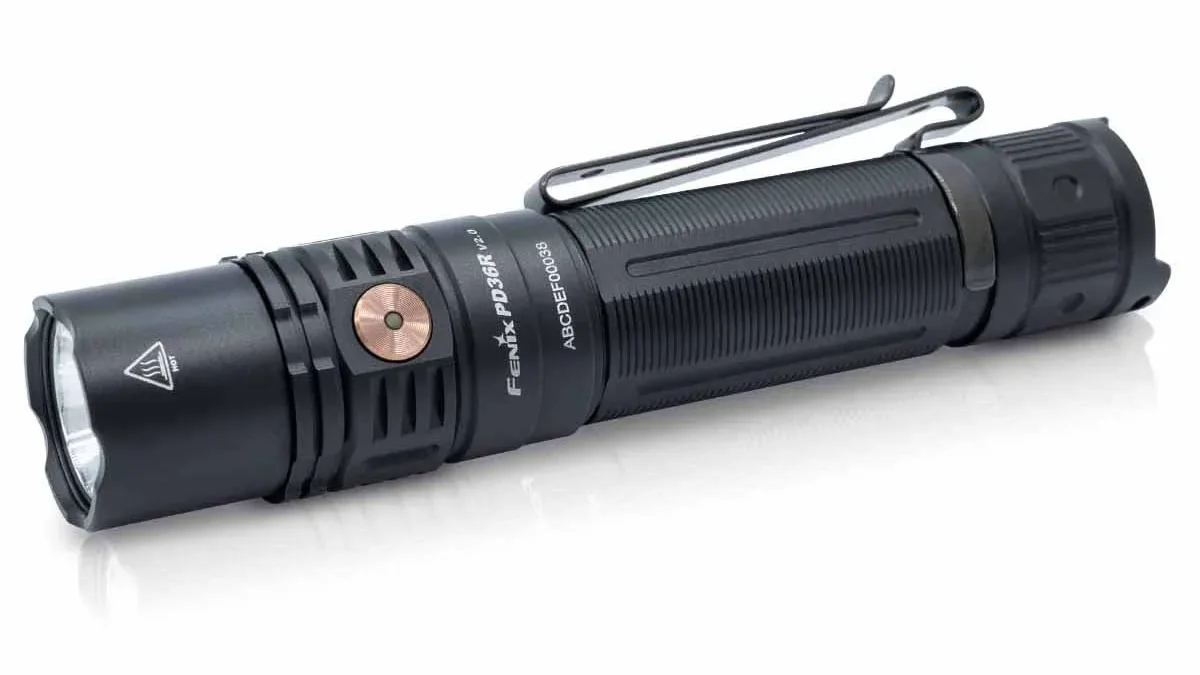
Image: Fenix
Best for: car camping, and anyone who wants one handheld that does everything.
The PD36R V2.0 is the light the rest of this list gets measured against. Fenix rates it at 1,700 lumens with a 396 m beam, enough to check the tree line or pick out a trail marker across a clearing. The other end of the range matters more at camp: a 5-lumen Eco mode and a maximum rated runtime of 482 hours. Five lumens is right for inside a tent or while someone else is asleep, and it’s why the light gets through a long weekend without a recharge.
The battery is a standard-size 21700 (Fenix’s own 5,000 mAh cell comes in the box), so a spare is easy to carry and swap in the dark. It charges over USB-C at up to 18 W, taking about 2.5 hours with a fast charger, which is worth knowing if you top it up from a car socket or a power bank. While it’s plugged in, only Eco mode works.
Trade-offs: 167 g with the battery is heavy for a backpack, the tint is a cool 6,500 K, and there’s no red mode. None of that matters much at a car campsite.
Want more output? The Fenix PD36R Pro pushes 2,800 lumens and a 380 m beam from almost the same body (169 g). For camping it’s the weaker pick: its longest rated runtime is 42 hours against the V2.0’s 482, and Fenix says Turbo is locked out once the battery falls to about half. Buy it only if you really want the extra top end.
Check the Fenix PD36R V2.0 on Amazon →
Best Flashlight for Backpacking: Acebeam Pokelit AA
Best for: backpackers and ultralight hikers who want a handheld backup.
On a backpacking trip your headlamp is the main light (our picks are in best headlamps for camping & running). If you carry a handheld as well, it should be small, last for days on a low mode, and never leave you without power. The Pokelit AA covers all three.
Acebeam lists it at 54.6 g, with 550 lumens on High and a 5-lumen Low that runs for 58 hours. It ships with a USB-C rechargeable 14500 cell, so it charges from the same power bank as your phone. When that runs flat, it takes one ordinary AA, alkaline or NiMH, from any trailhead store. It’s IP68 (submersible to 2 m), and its Nichia emitter is rated CRI 90 or higher, so colors look natural when you’re reading a map or sorting gear.
Trade-offs: three brightness levels and nothing else, not even a strobe. High is listed as 550 dropping to 330 lumens, so don’t count on full output for long. It costs $34.90 on Acebeam’s store.
Check the Acebeam Pokelit AA on Amazon →
Best Flashlight for Around Camp (Lantern Mode): Acebeam TAC 2AA
Best for: lighting a table or a tent, and campers who want an AA backup with more output.
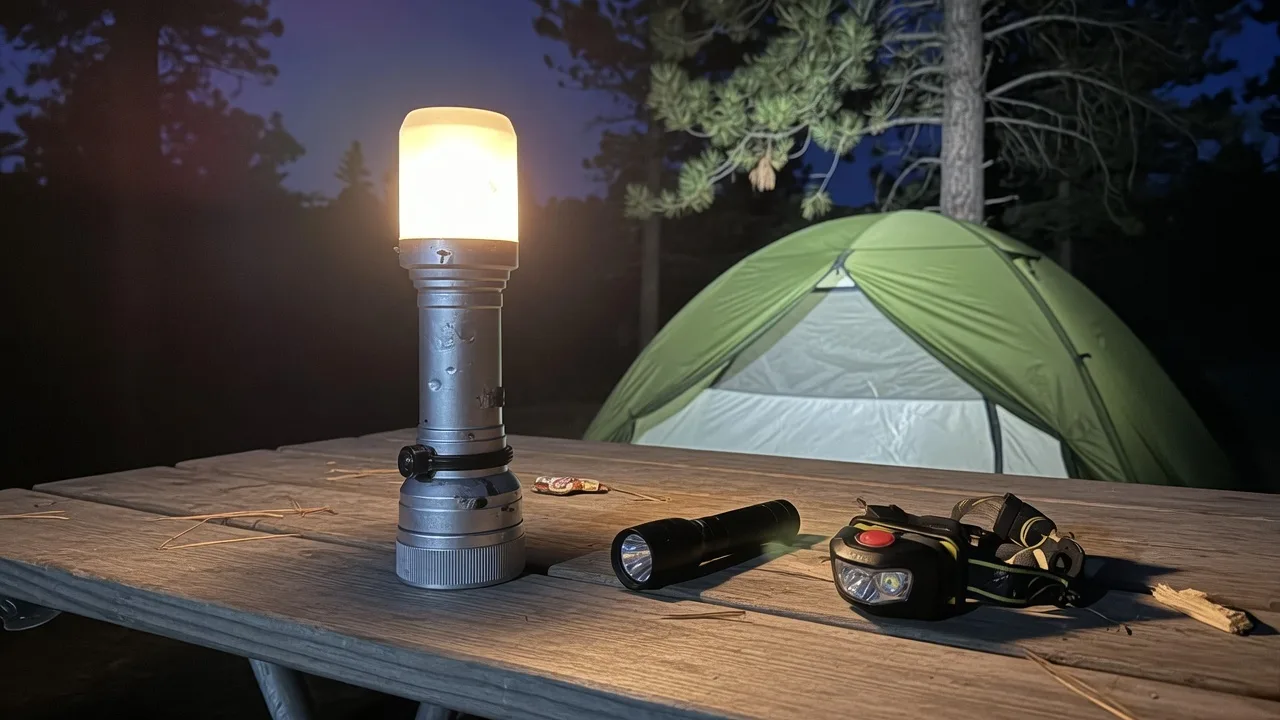
A flashlight makes a decent lantern if it can stand on its tail and spread its beam. The TAC 2AA does both: it tail-stands, and Acebeam’s own store sells it with a pair of diffuser caps, one white and one orange. Stand it on the camp table with the white cap on and it lights the space instead of dazzling whoever it points at. Check that the Amazon listing includes the caps before you buy.
The low modes are what make it work for this job. On the included rechargeable cell, Moon gives 1.6 lumens for 94 hours and Low gives 35 lumens for 36 hours. It also runs on two AA batteries, which matters on a long trip, but it’s a different light on AAs: Acebeam lists Turbo at about 630 lumens instead of 1,600 on NiMH cells, and Low drops to 24 hours. The body is IP68 (6.5 ft for 30 minutes), weighs 106 g and is drop-rated to 1.5 m.
Trade-offs: the 1,600-lumen headline needs Acebeam’s own rechargeable cell, and the tactical tail switch is one more thing to learn. It costs $49.90 on Acebeam’s store.
Check the Acebeam TAC 2AA on Amazon →
Best Flashlight for Emergencies and Bug-Out Bags: Nitecore P20iX
Best for: a light that lives in a go-bag, glovebox or storm kit and has to work after months untouched.
The case for the P20iX is its backup power. It normally runs on Nitecore’s rechargeable 21700 (a 5,000 mAh NL2150HPi is included), but it also takes two CR123A lithium cells, and Nitecore puts a CR123A magazine in the box. Energizer rates its lithium 123 cells to work from −40 °F to 140 °F, so a pair stored in the bag is a real fallback when there’s nothing to charge from.
Nitecore rates it at 4,000 lumens with a 221 m beam, IP68 to 2 m and impact-resistant to 2 m. The runtimes that matter are at the bottom of the mode chart: 50 lumens for 38 hours, and a 2-lumen Ultralow for 350 hours, according to Nitecore Store’s spec listing.
Trade-offs: the battery is Nitecore’s “i-series” 21700, and that same listing marks ordinary 21700 and 18650 cells as not compatible, so spares have to be Nitecore’s own or CR123As. It’s also a tactical light, with a glass-breaking strike bezel you’ll never need at camp. To build a whole blackout kit around it, see best flashlights for power outages.
Check the Nitecore P20iX on Amazon →
Best Budget Camping Flashlight: Fenix E12 V3.0
Best for: a cheap, dependable spare, a kid’s own flashlight, or the glovebox.
Fenix lists the E12 V3.0 at $29.95, and for that you get a light from a major maker, with published specs and a limited lifetime warranty, rather than a no-name tube with an invented lumen count. It makes 200 lumens, runs up to 100 hours on its lowest mode, and weighs 53.9 g including its single AA. It’s IP68, stands on its tail, has a magnet in the tail switch for sticking to a car door or a steel pole, and its two-way clip holds it on a cap brim for rough hands-free use.
It takes alkaline, NiMH or lithium AAs. Lithium is the one to pack for cold nights: Energizer rates its Ultimate Lithium AA to work from −40 °F to 140 °F, at 15 g a cell.
Trade-offs: 200 lumens won’t reach far, there are only three modes, and it can’t recharge itself. If you’ll use it often, buy a set of NiMH AAs.
Check the Fenix E12 V3.0 on Amazon →
What Matters in a Camping Flashlight
Runtime beats lumens. The headline number is a turbo mode you’ll use for seconds. What decides a trip is how long the light runs on the low setting you use all evening. Makers quote runtimes under the ANSI/PLATO FL1 standard, and Fenix notes that its figures include the time a light spends stepped down after it heats up. So compare the low-mode figures: 482 hours against 42 is the whole difference between the PD36R V2.0 and the Pro.
An AA fallback. Built-in and proprietary batteries are fine until the power bank is flat. A light that also takes AAs can be fed from any gas station, and lithium AAs keep working in the cold. Three of the picks here take AAs, but check which kind: Fenix lists lithium AAs as usable in the E12 V3.0, while Acebeam lists only alkaline and NiMH for its two. The P20iX’s fallback is CR123A.
A red light, on your headlamp. Red light protects your night vision and doesn’t dazzle the people you’re camping with. None of the flashlights here has a red mode, and few handhelds do. It’s a headlamp feature, which is one more reason the headlamp comes first. With a flashlight, use the lowest mode inside the tent instead.
Weight. The PD36R V2.0 is 167 g with its battery; the Pokelit and E12 are about 55 g. At a car campsite that doesn’t matter. In a pack, carry the small one.
Waterproofing. IPX4 handles rain. A light dropped in a creek needs IPX7 or better, which means rated for submersion. Every pick here is IP68 or rated submersible to 2 m. What the ratings and drop tests actually promise is covered in most durable flashlights for outdoor use.
Pack fire along with the lights. An arc lighter is windproof and recharges over USB, like most of the flashlights here.
FAQ
What is the best flashlight for camping? For most people, the Fenix PD36R V2.0. It has the long low-mode runtime, standard-size rechargeable battery and IP68 sealing that camping needs, plus enough reach (396 m) to see across a campsite. Backpackers should go smaller, with a light like the Acebeam Pokelit AA.
How many lumens does a camping flashlight need? Fewer than the box suggests. Inside the tent and around camp, 5–150 lumens covers almost everything, and 200–400 is plenty for walking a trail. High output only matters for spotting something far away, and it drains the battery fast.
Is a rechargeable or AA flashlight better for camping? Rechargeable is cheaper to run and fine for weekends if you carry a power bank. For long trips, a light that also takes AAs is safer, because spares are sold everywhere. The Pokelit AA and TAC 2AA do both. For cold weather, pick a light that accepts lithium AAs, which are rated to −40 °F; the Fenix E12 V3.0 does.
Should I take a headlamp or a flashlight camping? A headlamp first, because most camp jobs need both hands. The flashlight is your second light: for seeing further, for emergencies, and as a backup that doesn’t depend on the headlamp’s battery.
What waterproof rating does a camping flashlight need? IPX4 handles rain. IPX7 or IP68 survives being dropped in a stream, which is the realistic accident at camp. Every light on this list is IP68 or rated submersible to 2 m.
Can a flashlight work as a camping lantern? Yes, if it can stand on its tail and you diffuse the beam. Acebeam sells the TAC 2AA with diffuser caps on its own store; with any other light, stand it under a translucent water bottle.