Lumens vs Candela vs Beam Distance: What Flashlight Specs Mean
Quick answer: Lumens are how much light the flashlight makes in total. Candela is how much of it is concentrated into the beam. Lux is how much actually lands on the thing you’re looking at. A light can have enormous lumens and terrible reach, or modest lumens and huge reach — it depends entirely on the reflector. The one formula worth memorising: beam distance in metres = 2 × √candela. A light rated 10,000 cd throws 200 m. That’s it.
If you’ve ever bought a 2,000-lumen flashlight and been disappointed that it couldn’t light up a tree 150 m away, this article is why.
The Three Units, in Plain Terms
Picture a bucket of water.
- Lumens (lm) = how much water is in the bucket. Total light output, all directions summed.
- Candela (cd) = how tightly you’re aiming it. Water through a hose nozzle versus water tipped out. Same volume, completely different reach.
- Lux (lx) = how wet the target gets. Light per square metre arriving at a surface.
Formally: a lumen is total luminous flux. A candela is luminous intensity (it’s one of the seven SI base units, maintained in the US by NIST) — lumens per unit of solid angle, in one direction. A lux is one lumen spread over one square metre.
The relationship people never get taught:
lux = candela ÷ distance²
That’s the inverse square law, and it’s the reason flashlight marketing focuses on lumens. Lumens are a big impressive number that doesn’t depend on distance. Candela is the number that tells you what the light will actually do.
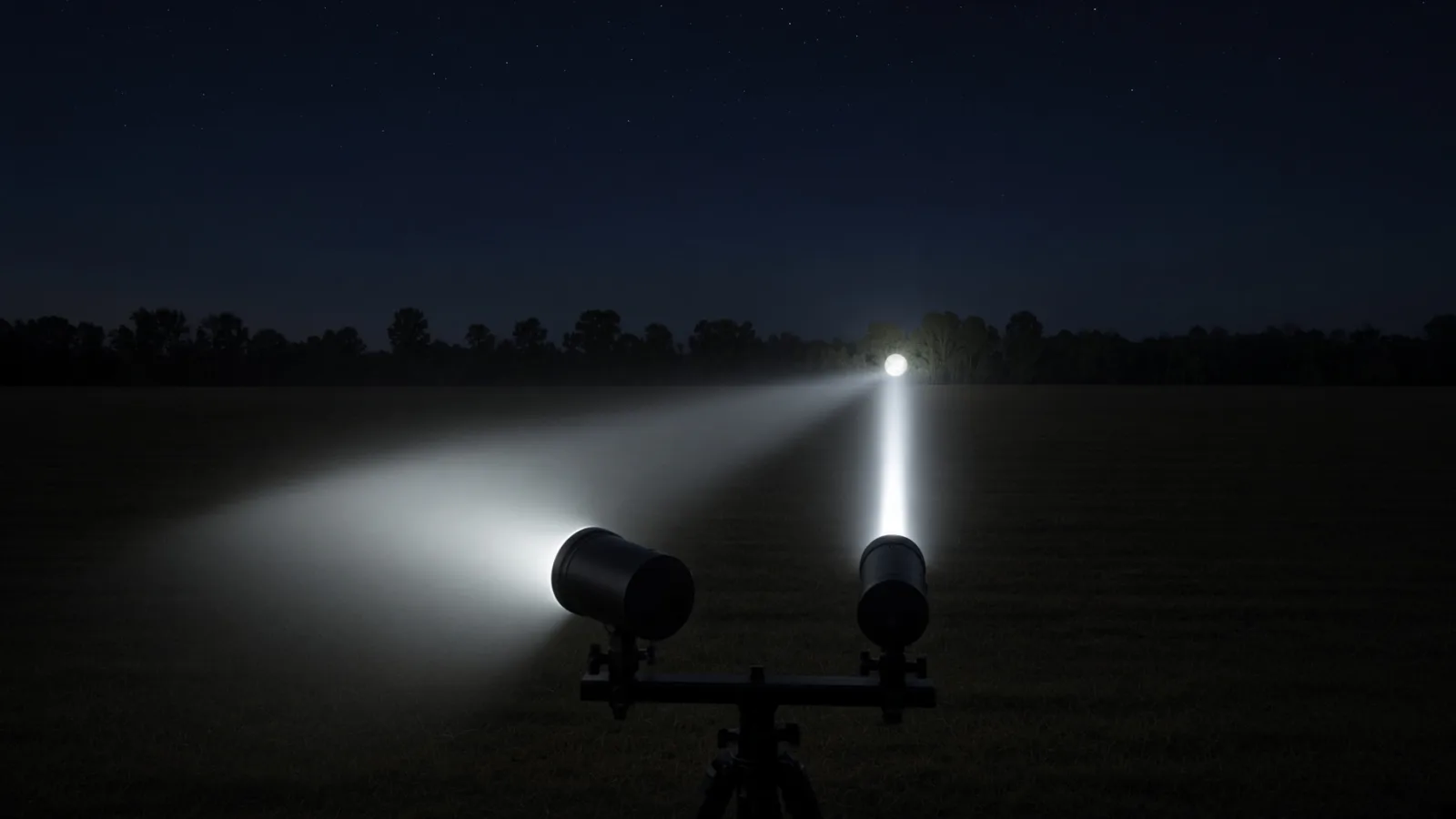
Why 2,000 Lumens Can Lose to 500
Take two real-world configurations:
| Flood light | Thrower | |
|---|---|---|
| Output | 2,000 lm | 500 lm |
| Peak intensity | 12,000 cd | 60,000 cd |
| Beam distance | ~220 m | ~490 m |
| What it’s good at | Lighting a whole campsite | Identifying something at range |
The flood light makes four times as much light and reaches less than half as far. Nothing is wrong with either — they’re solving different problems.
What separates them is optics. To concentrate light into a narrow beam you need a deep, wide reflector (or a large aspheric lens) and a physically small emitter. A small, intensely bright LED die at the focus of a big reflector produces a tight, far-reaching hotspot. A large die — which is how you get high lumens cheaply — can’t be focused as tightly, so the same light spreads out.
This is why throwers are long and fat at the head, and floodlights are short and stubby. The shape of the flashlight tells you what it does before you read a single spec.
The ANSI FL1 Standard, and What It Hides
Reputable manufacturers publish specs to ANSI/PLATO FL1 (originally published as ANSI/NEMA FL1 and now run by the Portable Lights American Trade Organization), which is why you see the same set of icons on flashlight packaging. Four numbers matter:
Beam distance (m). Defined as the distance at which the light produces 0.25 lux — roughly the illumination of a clear full moon. From lux = cd/d²:
d = √(candela ÷ 0.25) = 2 × √candela
So 2,500 cd = 100 m. 10,000 cd = 200 m. 40,000 cd = 400 m. 250,000 cd = 1,000 m.
Note the shape of that: to double your beam distance you need four times the candela. This is the single most important thing to understand about flashlight shopping. The jump from a 200 m light to a 400 m light is not a small upgrade — it’s a fundamentally bigger, more expensive light.
Here’s the catch nobody mentions: 0.25 lux is almost nothing. You can barely make out shapes. The distance at which you can actually identify what you’re looking at is roughly half the ANSI figure, sometimes less. A “300 metre” flashlight is a useful 150 metre flashlight. Halve every beam distance number you read and you’ll never be disappointed.
Output (lm). Measured in an integrating sphere at 30 seconds after switch-on. This matters because most modern lights step down from turbo within a minute or two to manage heat. The 30-second figure is real but temporary; the sustained output is often 30–50% of it.
Runtime (h). Measured until output falls to 10% of initial. So a light “rated 4 hours” spends much of hour four being dim. Compare runtimes on the mode you’ll actually use, not turbo.
Impact resistance and water rating. Drop height in metres, and an IPX code. IPX4 is splash, IPX7 is 1 m for 30 minutes, IPX8 is deeper.
Working the Numbers Yourself
You have candela, you want beam distance:
distance = 2 × √candela
40,000 cd → 2 × 200 = 400 m.
You have beam distance, you want candela:
candela = (distance ÷ 2)²
A light claiming 600 m → (300)² = 90,000 cd.
You want to know how bright it’ll be at a specific distance:
lux = candela ÷ distance²
40,000 cd at 50 m → 40,000 ÷ 2,500 = 16 lux. For reference, a well-lit corridor is 100–200 lux, civil twilight is around 3–10 lux, and full moonlight is about 0.25 lux. 16 lux at 50 m is genuinely useful light.
That last calculation is the one worth doing before buying. Decide the distance you actually care about, then check what the light delivers there.
Which Number Should You Shop On?
| Use case | Shop on | Rough target |
|---|---|---|
| EDC, around the house | Lumens | 300–1,000 lm, wide beam |
| Camping, campsite | Lumens + beam width | 200–500 lm, flood |
| Headlamp | Lumens, low-mode runtime | 300–500 lm max |
| Dog walking, trails | Both | 200–500 lm, 5,000–15,000 cd |
| Search & rescue, marine | Candela | 50,000+ cd |
| Astronomy, spotting | Candela | 100,000+ cd |
For everyday use, lumens is the right number — you want a broad wash of light nearby, and beam distance is irrelevant when the wall is three metres away. See how many lumens should a flashlight have? for use-by-use figures.
For anything at distance, ignore lumens and read candela. A long-throw flashlight with 150,000 cd and 800 lumens will outperform a 5,000-lumen floodlight at 300 m by a wide margin. Our long-range flashlight guide is built entirely around this number.
Two More Specs Worth Knowing
CRI (Colour Rendering Index). How accurately the light shows colour, on a 0–100 scale. Cheap cool-white LEDs sit around 70 CRI and make everything look washed-out and blue-green. A 90+ CRI light shows blood, wiring, wood grain and skin properly. It costs you maybe 10–15% of your lumens, and for close-up work it’s the best trade in flashlights. Several picks in best EDC flashlights under $50 offer high-CRI emitters.
Colour temperature (K). 6,500 K is cold blue-white, 5,000 K neutral, 4,000 K warm, 3,000 K distinctly yellow. Warmer tints cut through fog, rain and dust noticeably better, and cause less eye strain at night. Cool white measures higher in lumens, which is why budget lights default to it.
Common Claims and How to Read Them
“100,000 lumens!” on a cheap listing. Almost certainly false. Genuine output above about 10,000 lumens requires serious thermal mass and multiple emitters, and lasts seconds before step-down. Treat unverified five-figure lumen claims as fiction.
A big lumen number with no candela figure. Usually means the throw is unimpressive. Manufacturers publish the number that flatters them.
“Military grade” / “tactical”. Not defined by any standard. Meaningless without specs behind it. The $20 vs $100 flashlight comparison covers what price actually buys.
A runtime figure with no mode attached. It’s the lowest mode. Always.
Lumens quoted without ANSI FL1. Some brands quote “emitter lumens” — the theoretical output of the LED before losses in the reflector, lens and driver. Real out-the-front (OTF) output is typically 10–25% lower.
FAQ
What’s the difference between lumens and candela? Lumens measure total light output in every direction. Candela measures intensity in one direction — how concentrated the beam is. Two lights with identical lumens can differ tenfold in candela depending on their reflectors.
How do I convert candela to beam distance? Beam distance in metres = 2 × the square root of candela. 10,000 cd gives 200 m. To reverse it: candela = (distance ÷ 2)².
Is higher lumens always better? No. Beyond what you need, extra lumens cost runtime and heat while adding nothing. For distance you want candela; for close work you want beam width and CRI.
What is lux? Illuminance — lumens landing per square metre. It’s what a light meter reads, and it’s the number that describes how bright a surface actually looks. lux = candela ÷ distance².
Why does my 1,000-lumen flashlight look dimmer than the box suggests? Three usual reasons: ANSI output is measured at 30 seconds and the light has since stepped down for heat; the beam is wide so the light is spread thin; or the figure was emitter lumens rather than out-the-front.
What is ANSI FL1? The industry standard for flashlight specs — output at 30 seconds, runtime until 10% of initial output, beam distance to 0.25 lux, impact resistance, and water ingress rating. It makes brands comparable, but you still need to know what each measurement excludes.
How much candela do I need? For everyday use, under 5,000 cd is fine. For dog-walking and trails, 5,000–15,000 cd. For genuine long-range identification, 50,000 cd and up — and remember that useful distance is about half the rated figure.