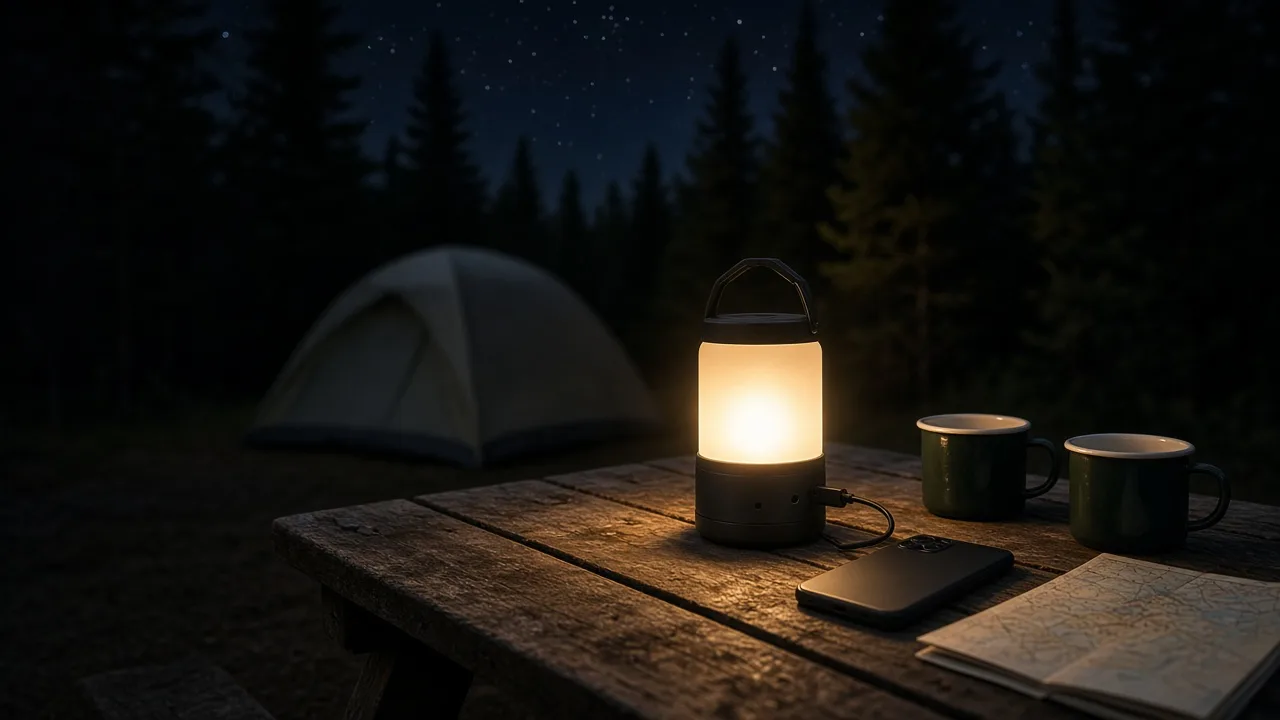
The Best Rechargeable Camping Lanterns (2026): 4 Picks
Quick answer: The best rechargeable lantern for camping is the Fenix CL28R. It does up to 2,000 lumens, runs up to 360 hours on its lowest setting, lets you dial the light from warm to cool, and charges a phone from its 10,000 mAh battery. If you want a battery you can swap, get the Fenix CL26R Pro. For storm kits and off-grid trips, the Goal Zero Lighthouse 600 adds a hand crank. Backpackers should take the 87 g Goal Zero Lighthouse Micro Charge.
A lantern does a different job from a flashlight. It lights the whole picnic table or tent so nobody spends the evening being dazzled by someone else’s headlamp. If you’re still deciding which lights to bring, start with headlamp vs handheld vs lantern. This page picks the lantern.
How we picked: we haven’t bench-tested these lanterns. Each one is compared on its maker’s published specs, linked in its section, and each Amazon listing was checked in stock for a US address on November 3, 2026. We weighted the numbers that decide a camping trip: low-mode runtime, how it charges, how much it can top up a phone, and how warm the light is.
The Best Rechargeable Camping Lanterns at a Glance
| Lantern | Best for | Max output | Longest runtime | Battery | Charges a phone? | Weight |
|---|---|---|---|---|---|---|
| Fenix CL28R | Car camping, all-round | 2,000 lm | 360 h | Built-in, 10,000 mAh, USB-C | Yes, USB-C and USB-A | 376 g |
| Fenix CL26R Pro | Swappable battery | 650 lm | 408 h | 21700, 5,000 mAh, USB-C | Yes, USB-A | 199 g without battery |
| Goal Zero Lighthouse 600 | Off-grid and storm kits | 600 lm | 320 h (one side) | Built-in, 5,200 mAh, USB, crank, solar | Yes, USB | 498 g |
| Goal Zero Lighthouse Micro Charge | Backpacking | 150 lm | 170 h (one side) | 18650, 2,600 mAh, USB | Yes, USB (5 W) | 87 g |
All figures are the makers’ published specs. Fenix gives the CL26R Pro’s weight without its battery.
Best Rechargeable Lantern Overall: Fenix CL28R
Best for: car camping, family trips, and a lantern that doubles as a power bank at home.
Fenix rates the CL28R at 2,000 lumens, with stepless brightness and a color temperature you can turn from a warm 2,700 K to a cool 6,000 K. That second dial matters more than the lumen figure. Warm light is easier on the eyes at the table, and you can switch to cool white when you’re hunting for a dropped tent stake. The longest rated runtime is 360 hours, which is about 15 days on the lowest setting.
Inside are two built-in 5,000 mAh cells, 10,000 mAh in total. The lantern charges over USB-C in about four hours with fast charging, and it can charge your phone through either its USB-C or USB-A port (one at a time). That makes it a sensible lantern to keep for power outages too. It also has a separate red light with a flashing mode, a handle that rotates 360°, a magnetic base and a standard tripod socket.
Trade-offs: the batteries aren’t replaceable, so when they wear out, the lantern is done. Fenix doesn’t publish an IP rating; its FAQ says the light is waterproof only with the port cover closed. At 376 g it’s for the car, not the pack. Fenix covers it with a limited lifetime guarantee.
Check the Fenix CL28R on Amazon →
Best Lantern with a Swappable Battery: Fenix CL26R Pro
Best for: long trips, and anyone who already carries 21700 cells for a flashlight.
The CL26R Pro runs on a standard 21700 battery that you can take out (Fenix includes a 5,000 mAh cell). That’s the feature that sets it apart: carry a charged spare and you have a fresh lantern without needing an outlet. If you already carry 21700 cells for a flashlight from our camping flashlight picks, check that they’re the same type before you count on them as spares.
Fenix lists nine modes. There’s a 360° lantern mode, a separate down-light for lighting a table, and red steady and flashing modes. The maximum runtime is 408 hours. It charges over USB-C in about 3.5 hours and has a USB-A port to charge a phone, though High isn’t available while it’s charging something. A retractable hook and a magnetic top make it easy to hang from a tent loop or stick to a car roof.
Trade-offs: output peaks at 650 lumens (Fenix’s own page also describes a 500-lumen High), so it’s dimmer than the CL28R. The light runs cool, from about 4,000 to 6,800 K, and there’s no published IP rating. The Amazon listing we checked had only a few left in stock, so check availability before you plan around it.
Check the Fenix CL26R Pro on Amazon →
Best for Off-Grid Trips and Storm Kits: Goal Zero Lighthouse 600
Best for: long trips without power, and the emergency kit at home.
The Lighthouse 600 can charge three ways. Goal Zero lists USB, solar and a built-in hand crank. The crank is the part that matters in an emergency: Goal Zero says one minute of cranking gives about ten minutes of light on low. It won’t refill the battery, but it means the lantern is never completely dead.
The light is a warm 3,500 K, split across two sides you can switch on separately. With one side lit, Goal Zero rates it at 320 hours on low and 5 hours on high. With both sides, it’s 180 hours on low. The 5,200 mAh battery can charge a phone from the USB output at up to 7.5 W.
Trade-offs: it’s the heaviest pick here at 498 g. USB input is only 5 W, so charging from a wall plug is slow. There’s no red mode and no published water rating, and the warranty is two years, not lifetime. When we checked on November 3, Amazon was quoting delivery for late November to mid-December, so order early if it’s going in a holiday gift or a winter storm kit.
Check the Goal Zero Lighthouse 600 on Amazon →
Best Rechargeable Lantern for Backpacking: Goal Zero Lighthouse Micro Charge
Best for: backpackers, and a small lantern for inside the tent.
At 87 g, the Lighthouse Micro Charge weighs about the same as a headlamp. It’s a lantern at one end and a small flashlight at the other. In lantern mode it gives up to 150 lumens of warm 3,800 K light, and with one side lit, Goal Zero rates it at 170 hours on low and 15 hours on high. Inside a tent, low is all you’ll use.
The 2,600 mAh 18650 cell charges over USB in about 3.5 hours, or from a small Goal Zero solar panel. It can also top up a phone at 5 W, which is slow but works in an emergency. It’s rated IPX6, so heavy rain and splashes aren’t a problem, but it isn’t made to be submerged.
Trade-offs: 150 lumens is enough for a tent, not a whole group campsite. The output is the same 5 W as a basic USB charger, and the warranty is two years. On a backpacking trip your headlamp still comes first.
Check the Goal Zero Lighthouse Micro Charge on Amazon →
How to Choose a Rechargeable Lantern for Camping
Runtime on low beats max lumens. You’ll run a camp lantern on its low setting for hours every night. A 2,000-lumen High drains any battery fast. The number that matters is the longest runtime: every pick here is rated over 150 hours.
Warm light is easier to live with. A lantern under 4,000 K, like the Goal Zero models or the CL28R turned down to 2,700 K, makes faces look normal and is easier on the eyes. Cool white is better for finding things. The CL28R’s adjustable color temperature gives you both.
Check how it charges. USB-C charges fastest. The Fenix lanterns use it. The Goal Zero models list a 5 W USB input, so plan on a longer top-up. For trips longer than a weekend, bring a power bank, a solar panel, or a swappable battery like the CL26R Pro’s.
Power-bank output is a bonus, not the point. A lantern with a 5,000–10,000 mAh battery can charge a phone, but every bit you take out comes off your lantern runtime. Use it to get through an emergency, not as your main phone charger.
Red light protects night vision. Both Fenix lanterns have a red mode. It’s useful inside the tent at 2 a.m. without waking everyone.
Water resistance. Only the Micro Charge publishes a rating (IPX6). Fenix says its lanterns are waterproof with the port cover closed. None of these is made to go underwater, so hang them under the tent fly or a tarp in the rain. What the ratings actually mean is in our durable flashlights guide.
Using it in a power outage. The same lantern works at home. Pick one with a long low mode, keep it charged, and store it where you can find it in the dark. Our power outage flashlight guide covers the rest of the kit.
Bring a way to light the stove too. An arc lighter recharges over USB like these lanterns and doesn’t blow out in wind.
FAQ
What is the best rechargeable lantern for camping? For most people, the Fenix CL28R. It has up to 360 hours of runtime on low, adjustable warm-to-cool light, a red mode, and a 10,000 mAh battery that can charge a phone. Backpackers should carry the much lighter Goal Zero Lighthouse Micro Charge.
How many lumens does a camping lantern need? Less than you’d think. Around 50–150 lumens lights a picnic table, and 10–30 lumens is plenty inside a tent. Higher output is useful for setting up camp in the dark or lighting a large group site.
How long does a rechargeable lantern last on one charge? It depends on the brightness. On low, our picks are rated from 170 hours (Lighthouse Micro Charge, one side) to 408 hours (Fenix CL26R Pro). On high, expect a few hours.
Is a rechargeable or battery lantern better for camping? Rechargeable is cheaper to run and fine for weekends if you bring a power bank. For long trips or emergency storage, a lantern with a swappable battery, a hand crank or solar charging is safer. Lanterns that take D or AA cells are worth keeping at home because the batteries store for years.
Can a camping lantern charge my phone? All four picks here can. The Fenix CL28R has the biggest battery (10,000 mAh) and both USB-C and USB-A outputs. The Goal Zero Micro Charge’s 5 W output is slow, so treat it as an emergency top-up.
Can I leave a rechargeable lantern in the car? Not in summer. Goal Zero rates the Lighthouse 600 for use between 32 and 104 °F, and a parked car in the sun gets far hotter than that. Heat is hard on lithium batteries, so bring the lantern inside between trips.
Can I use a flashlight as a camping lantern? Yes, if it can stand on its tail and you diffuse the beam. Our camping flashlight picks include one sold with diffuser caps.