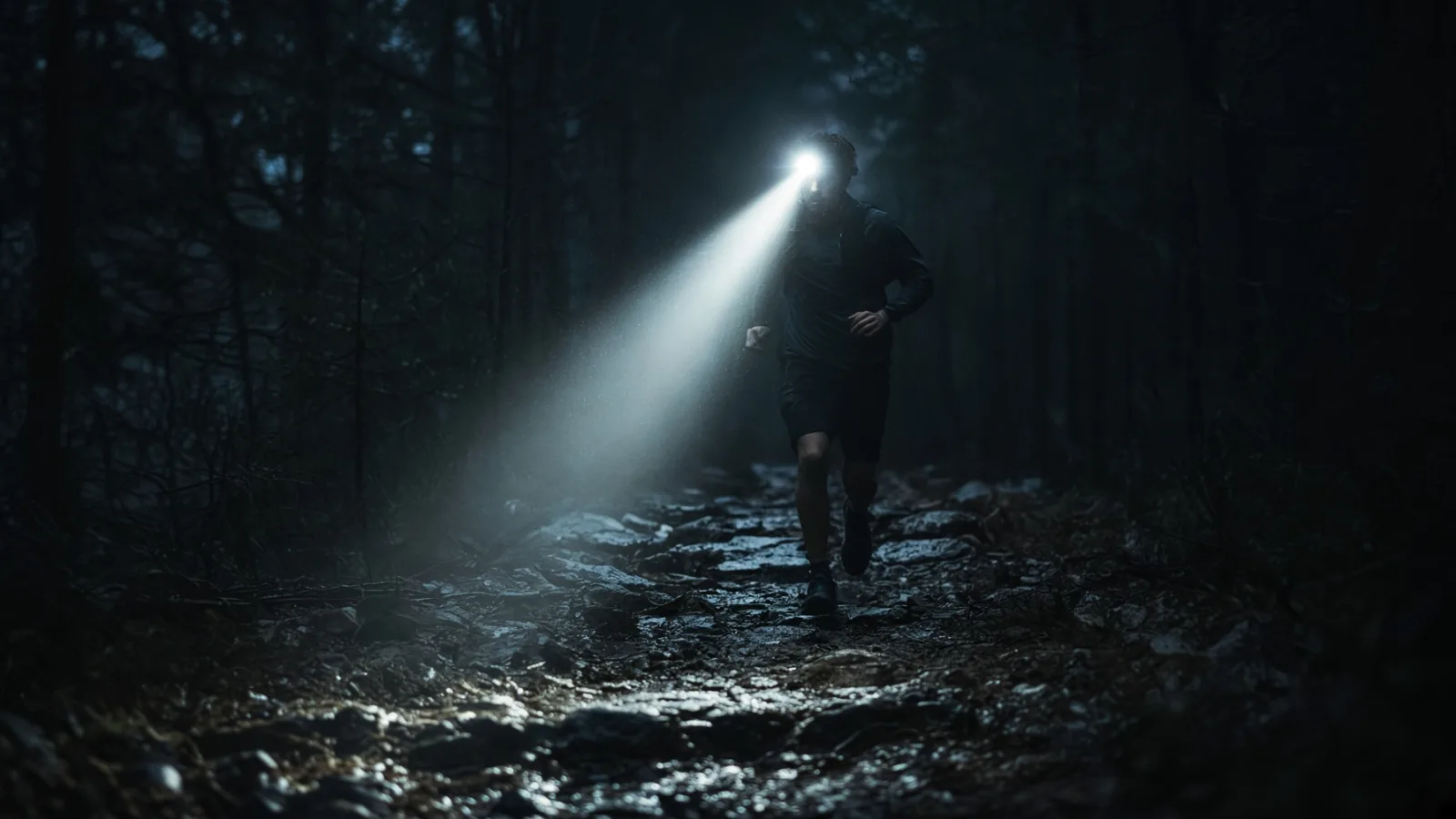
Best Headlamps for Camping & Running (2026): 5 Tested Picks
Quick answer: For camping, buy the Petzl Actik Core — it runs on a rechargeable pack or three AAAs, which is the feature that matters on a long trip. For running, buy the BioLite HeadLamp 425 if you care about it not bouncing, or the Petzl Swift RL if you run technical trails at speed and want the beam to adjust itself. If you just want the lightest competent light for the least money, the Nitecore NU25 UL weighs 45 g and does almost everything.
Headlamps get bought on lumens and regretted on everything else. A camping headlamp is judged on how long it runs at 30 lumens; a running headlamp is judged on whether it stays still on your forehead at 6 mph in the rain. These are close to opposite design problems, which is why one “best headlamp” list that ignores the distinction is useless.
Camping vs Running: What Actually Differs
| Camping | Trail running | |
|---|---|---|
| Output you use | 20–80 lm | 200–500 lm |
| Runtime that matters | Low mode, 20–60 h | High mode, 2–6 h |
| Weight limit | 100 g is fine | Under 100 g, ideally under 80 |
| Beam priority | Wide flood, close | Flood and 30–50 m of throw |
| Red mode | Essential | Nice to have (rear light matters more) |
| Battery strategy | Swappable spares | Rechargeable, sometimes rear-mounted |
| Deal-breaker | Dead by night two | Bounce |
The one spec both share is beam quality over raw output. A 400-lumen light with a clean, wide hotspot beats an 800-lumen light that throws a bright ring with a dark centre — in a tent and on a trail alike.
The Comparison
| Petzl Actik Core | Black Diamond Spot 400-R | Nitecore NU25 UL | BioLite HeadLamp 425 | Petzl Swift RL | |
|---|---|---|---|---|---|
| Max output | 600 lm | 400 lm | 400 lm | 425 lm | 1,100 lm |
| Weight | ~88 g | ~88 g | 45 g | ~85 g | ~100 g |
| Power | CORE pack or 3× AAA | Rechargeable (built-in) | Built-in, USB-C | Built-in, rear-mounted | Rechargeable pack |
| Water rating | IPX4 | IP67 | IP66 | IPX4 | IPX4 |
| Red mode | Yes | Yes | Yes (+ high-CRI) | Yes (front + rear strobe) | No |
| Standout | Hybrid battery | Waterproofing | Weight | Doesn’t bounce | Reactive auto-dimming |
| Best for | Camping, all-round | Wet weather, kayaking | Backpacking, budget | Road & trail running | Fast technical trails |
Headlamp model numbers get revised often — Petzl and Black Diamond both bump output on the same product name every couple of years. Check the current listing’s spec before buying, and treat these figures as the generation on sale in 2026.
1. Petzl Actik Core — Best Overall for Camping
The Actik Core’s headline number is 600 lumens, but that isn’t why to buy it. Buy it for the hybrid battery: it ships with Petzl’s CORE rechargeable pack, and when that dies you pull it out and drop in three AAAs.
That sounds mundane until you’re on day four of a trip with no power. Every fully-sealed rechargeable headlamp becomes a paperweight at that point. The Actik becomes a headlamp that runs on batteries from any petrol station. For anything longer than a weekend, this is the single most valuable feature on the list.
Otherwise it’s a well-sorted camping light: a genuine wide flood for camp tasks, a mixed beam for walking, a red mode that doesn’t cycle through white first (a small thing that stops you blinding your tent-mate at 2 a.m.), and a washable headband.
The catch: IPX4 only. It shrugs off rain; it will not survive a dunk in a stream. If you’re around water, the Black Diamond below is the better call.
Best for: almost everyone camping. It’s the default recommendation for a reason.
2. Black Diamond Spot 400-R — Best Waterproofing
IP67 is the spec that separates this one: dust-tight, and good for 1 m of immersion for 30 minutes. Most headlamps in this price band are IPX4, which means “rain, briefly.” The Spot 400-R is the one you take kayaking, canyoning, or camping in a genuinely wet week.
The 400-lumen output is enough for everything short of running fast, and Black Diamond’s dimming is smooth rather than stepped, so you can dial in the low output camp chores actually need. Red, green and blue night-vision modes and a lock-out round it out.
It’s fully rechargeable with no AAA fallback, which is the trade-off against the Actik. If your trips are short and you carry a power bank, that costs you nothing.
Best for: wet conditions, and anyone who has already killed a headlamp by getting it wet.
3. Nitecore NU25 UL — Best Ultralight and Best Value
45 grams, 400 lumens, USB-C. The NU25 UL is the light that makes you question why the others weigh twice as much.
The UL revision swapped the old braided strap and heavier housing for a minimal build, and the result is a headlamp you stop noticing. It runs three outputs — a white flood, a high-CRI beam that makes colours look right (genuinely useful for cooking, first aid, or reading a map), and red for night vision.
At this weight and price it’s the obvious backpacking choice, and it’s also the sensible “keep one in the car / one in the emergency kit” light. It pairs well with the rest of a blackout kit.
The catch: the ultralight strap is less comfortable than Petzl’s over long periods, and there’s no battery swap. Carry a small power bank.
Best for: backpackers counting grams, and anyone who wants 90% of a premium headlamp for a third of the price.
4. BioLite HeadLamp 425 — Best for Running Comfort
BioLite solved the problem every runner has with headlamps: bounce. The light housing sits flush against a moisture-wicking fabric band rather than perched on a plastic bracket, and the battery moves to the back of your head, which balances the whole thing front-to-rear.
The practical result is that it stays put. Most headlamps at this weight develop a slow nod at running cadence that becomes maddening over an hour. This one doesn’t. It also has a rear red strobe, which matters more than most runners realise — if any part of your route is on a road, being seen from behind is the actual safety feature.
425 lumens with a “run-forever” mode that lets it run indefinitely off a power bank in your pack.
The catch: IPX4, and the fabric band takes longer to dry than a strap. Fine for rain, not for a downpour every day.
Best for: road and moderate trail running, and anyone who has abandoned a headlamp because of bounce.
5. Petzl Swift RL — Best for Fast Technical Trails
1,100 lumens and REACTIVE LIGHTING: a sensor reads the light bouncing back at you and adjusts output continuously. Look down at your feet and it dims; look up the trail and it floods. In practice it means you get maximum output exactly when you need distance and nothing more, so battery life stretches far past what a fixed 1,100-lumen mode would give.
For technical descents at speed, this is a meaningful advantage rather than a gimmick — your eyes stay adapted, and you’re not manually cycling modes with cold hands.
The catch: it’s expensive, there’s no red mode, it’s IPX4, and at ~100 g it’s the heaviest here. It’s a specialist tool for people who race or train on trails in the dark, not a general-purpose camping light.
Best for: trail runners, night orienteering, fast-and-light mountain use.
What to Ignore, and What to Check
Ignore the max lumen number. Turbo modes on headlamps typically step down within a few minutes to control heat, and you’ll spend 95% of your time on low or medium. The number worth finding is low-mode runtime.
Check for a lock-out. Headlamps switch themselves on inside packs constantly. A lock-out (usually a long press, or physically reversing a battery) is the difference between a working light and a flat one at the trailhead.
Check the red mode sequence. Some lights make you cycle through full white to reach red, which defeats the point. The good ones reach red directly from off.
Check the tilt ratchet. A bracket that slips under vibration is the other cause of a nodding beam. Firm detents matter more than the number of positions.
Cold weather changes the answer. Lithium-ion capacity drops sharply below freezing, which is another argument for the Actik Core’s AAA fallback — lithium primary AAAs are rated down to −40 °C. Same logic applies to your fire source: butane loses pressure near freezing, so an arc lighter is the reliable cold-weather option.
Where a Headlamp Fits in Your Kit
A headlamp is the first camping light to buy, not the only one. It’s poor at lighting a shared space — everyone gets dazzled every time you look at them — and poor at distance. The full breakdown of headlamp vs lantern vs handheld is in what is the best torch for camping?, and if you want a handheld to go alongside, best EDC flashlights under $50 covers the pocket-sized end. For specific handheld picks by trip type, see the best camping flashlights.
FAQ
How many lumens do I need in a headlamp? For camping, 200–400 max output is plenty — you’ll use 20–80 lumens most of the time. For running, aim for 300–500 usable output, with beam shape mattering as much as the number. More detail in how many lumens should a flashlight have?.
Rechargeable or AAA headlamps? Rechargeable for weekends and anywhere you can charge. Hybrid (like the Actik Core) for long trips and cold weather, where swappable lithium AAAs are a genuine safety margin.
Why does my headlamp bounce when I run? Weight distribution. A front-heavy light on a thin strap nods at running cadence. Rear-mounted batteries and wide fabric bands fix it — that’s the BioLite’s whole design premise.
Do I need a red light on a headlamp? For camping, yes — it preserves dark adaptation, doesn’t dazzle other people, and attracts fewer insects. For running, a rear red strobe matters more than a front red mode.
What water rating should I look for? IPX4 handles rain and is the practical floor. IP67 or IPX7 survives immersion and is worth paying for if you’re near water.
Are expensive headlamps worth it? Up to a point. The jump from a $15 no-name to a $40 Nitecore or Black Diamond buys real beam quality, regulation and waterproofing. Above about $80 you’re paying for reactive lighting, hybrid batteries, or race-specific features — worth it only if you’ll use them.